
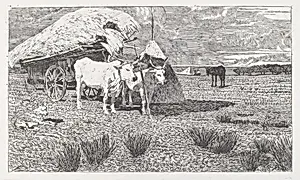
Oxen Yoked to a Cart (Maremma) (Bovi al carro (Maremma))
1886/1887
Medium
etching on wove paper [artist's proof (?), before reduction of the plate (?)]
Dimensions
sheet: 36.8 × 49.6 cm (14 1/2 × 19 1/2 in.) plate: 24.8 × 42.2 cm (9 3/4 × 16 5/8 in.)
Classification
Department
CG-E
Museum
National Gallery of Art, Washington, D.C.
Credit
The Ahmanson Foundation
Accession Number
2013.28.3
Rights
Public Domain
Art Historical Context
Giovanni Fattori's *Oxen Yoked to a Cart (Maremma)* (1886/1887) captures the rugged beauty of Tuscany's Maremma region a wild coastal area known for its marshlands and pastoral life. As a leading figure in the Macchiaioli movement—an Italian precursor to Impressionism—Fattori celebrated everyday rural scenes with a focus on natural light and effects. Here, sturdy oxen pull a laden cart, evoking the timeless labor of Tuscan farmers and the harmony between humans, animals, and landscape. This etching on wove paper, possibly an artist's proof before the plate's reduction, showcases Fattori's mastery of printmaking. Etching allowed him to translate the Macchiaioli's loose, light-filled brushwork into intricate lines incised by acid on a metal plate. The generous sheet (36.8 × 49.6 cm) preserves the full composition, offering visitors a rare glimpse into the artist's experimental process. Printed in soft, nuanced tones, it highlights his skill in rendering texture—from the oxen’s hides to the dusty earth. Housed in the National Gallery of Art thanks to The Ahmanson Foundation, this print reflects late 19th-century Italy's artistic shift toward realism and modernity. Fattori's work bridges painting and graphics, inviting us to appreciate the dignity of rural toil amid evolving industrial times. A testament to his enduring legacy, it draws us into Maremma's timeless rhythms.
About the Artist
Giovanni Fattori · 1825–1908
Giovanni Fattori (1825–1908) was born in Livorno and showed such aptitude for drawing that his family redirected him from a planned commercial education to an artistic apprenticeship under the local painter Giuseppe Baldini. In 1846 he moved to Florence, where he studied under Giuseppe Bezzuoli and attended the Academy of Fine Arts. His early work followed the conventions of historical and religio...