
Pa. German Cabbage Cutter
c. 1941
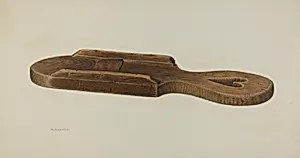
Medium
watercolor and graphite on paper
Dimensions
overall: 29.3 x 53.9 cm (11 9/16 x 21 1/4 in.) Original IAD Object: 20 7/8" long; 6 5/16" wide
Classification
Index of American Design
Department
CG-W
Museum
National Gallery of Art, Washington, D.C.
Credit
Index of American Design
Accession Number
1943.8.3810
Rights
Public Domain
Art Historical Context
Behold the *Pa. German Cabbage Cutter a meticulous watercolor and graphite rendering by Nicholas Amantea, created around 1941. This detailed depiction captures a traditional wooden tool from Pennsylvania German folk culture—measuring about 20⅞ inches long and 6¼ inches wide—designed for efficiently shredding cabbage into sauerkraut, a staple in the hearty diets of 18th- and 19th-century German immigrant communities in Pennsylvania. As part of the Index of American Design (IAD), a Federal Art Project under the Works Progress Administration during the Great Depression, Amantea's work exemplifies a national effort to document and celebrate everyday American craftsmanship. From 1935 to 1942, artists like him produced over 15,000 precise renderings of folk art objects, preserving vanishing traditions amid rapid modernization. This piece highlights the ingenuity of Pennsylvania Dutch makers, whose carved and functional designs blended European heritage with practical American needs. Amantea's use of watercolor for vibrant wood tones and graphite for sharp contours creates a lifelike study that's both artistic and archival. Housed in the National Gallery of Art's collection, it invites us to appreciate how simple tools embodied cultural resilience and community life.
About the Artist
Nicholas Amantea · 1900–1978
Nicholas Amantea (1900–1978) was an American artist born on July 13, 1900, in Pittsburgh, Pennsylvania. His early life and artistic training are not well documented, but by the mid-1930s, he had established himself in New York City, where he contributed significantly to federal art initiatives during the Great Depression. From March 13, 1936, to July 15, 1942, Amantea worked for the Works Progress...