
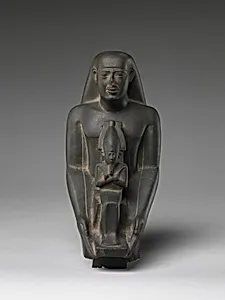
Padiamunrenebwaset, son of Irethoreru, holding a seated statue of Osiris
Unknown Artist
4th century B.C., late
Medium
Green schist
Dimensions
H. 22.5 cm (8 7/8 in.); W. 10.4 cm (4 1/8 in.); D. 12.2 cm (4 13/16 in.)
Classification
Statue, Padiamunrenebwaset, Osiris
Period
Ptolemaic Period
Department
Egyptian Art
Museum
Metropolitan Museum of Art, New York, NY
Credit
Rogers Fund, 1907
Accession Number
07.228.33
Rights
Public Domain
Tags
Art Historical Context
In the late 4th century B.C., during Egypt's Ptolemaic Period this green schist statue depicts Padiamunrenebwaset, son of Ioreru—a figure whose Theban name honors the god Amun and the city of Waset (Thebes). Carved to a modest height of 22.5 cm, the man stands rigidly, cradling a seated statue of Osiris, the ancient god of the underworld, resurrection, and eternal life. This intimate grouping reflects deep religious devotion, likely serving as a votive or funerary offering to ensure the deceased's favor in the afterlife. Green schist, a durable metamorphic stone prized for its vibrant hue symbolizing rebirth and fertility, was a fitting medium for Osiris-themed works. The sculpture's precise carving captures the idealized Egyptian proportions and hieroglyphic detailing typical of Ptolemaic art, blending traditional pharaonic styles with subtle Hellenistic influences under Greek Ptolemaic rule. Such statues were common in temples or tombs, embodying personal piety amid a era of cultural fusion. Acquired through the Rogers Fund in 1907, this piece from the Metropolitan Museum of Art's Egyptian collection offers a window into everyday elite spirituality, reminding us how ordinary individuals sought divine protection through enduring stone.