
Padlock
Unknown Artist
probably 18th century
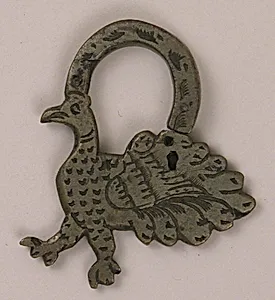
Medium
Brass
Dimensions
H. 1 7/8 in. (4.8 cm) W. 1 9/16 in. (4 cm) D. 3 /16 in. (0.5 cm) Wt. 0.8 oz. (22.7 g)
Classification
Metal
Department
Islamic Art
Museum
Metropolitan Museum of Art, New York, NY
Credit
Rogers Fund, 1910
Accession Number
10.100.187
Rights
Public Domain
Tags
Art Historical Context
This diminutive brass padlock, crafted in the 18th, exemplifies the exquisite metalwork of the Islamic world. Measuring just 1 7/8 inches high weighing a mere 0.8 ounces, it was designed for practical security—perhaps securing doors, chests, or valuables—yet its small scale demanded remarkable precision from the unknown artisan. The inclusion of bird motifs, as noted in its classification, adds a decorative flourish typical of Islamic metal objects, transforming a utilitarian item into a work of subtle artistry. In the Islamic art tradition, brass was prized for its malleability and golden sheen, allowing techniques like casting, engraving, or chasing to create intricate designs. Padlocks like this one highlight everyday craftsmanship from regions such as the Ottoman Empire or Persia, where functionality met aesthetic refinement. These objects bridged the domestic and the decorative, reflecting a culture that valued beauty in the mundane. Acquired through the Rogers Fund in 1910 and now housed in The Metropolitan Museum of Art's Islamic Art department, this padlock invites us to appreciate the overlooked artistry of historical daily life—proof that even the tiniest artifacts can unlock stories of skill and ingenuity.