
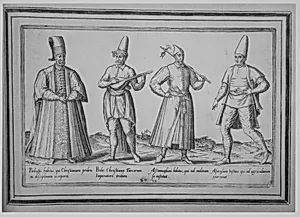
Paedagogi habitus, qui Christianam prolem in disceplinam acceperit; Proles Christiana Turcorum Imperatori tributa; Assamoglani habitus, qui ad militiam se instituit; Asmoglam vestituis qui ad agriculturam exercetur
Medium
Engraving
Dimensions
Image: 7 13/16 × 12 11/16 in. (19.9 × 32.2 cm) Frame: 9 1/2 × 14 5/16 in. (24.2 × 36.4 cm) Sheet: 21 5/16 × 16 5/16 in. (54.2 × 41.5 cm) Book: 21 7/8 × 16 3/4 × 1 15/16 in. (55.5 × 42.5 × 5 cm)
Classification
Books|Prints|Ornament & Architecture
Department
Drawings and Prints
Museum
Metropolitan Museum of Art, New York, NY
Credit
Rogers Fund, 1921
Accession Number
21.44(117)
Rights
Public Domain
Tags
About this artwork
Paedagogi habitus, qui Christianam prolem in disceplinam acceperit; Proles Christiana Turcorum Imperatori tributa; Assamoglani habitus, qui ad militiam se instituit; Asmoglam vestituis qui ad agriculturam exercetur by Abraham de Bruyn|Joos de Bosscher, 1580. Created in Engraving, this work exemplifies the artistic practices and cultural values of its period. The piece reflects the technical skills and aesthetic sensibilities characteristic of its historical and cultural context. As part of the D...
Art Historical Context
This 1580 engraving by Flemish artist Abraham de Bruyn, published by Joos de Bosscher, presents four distinct figures illustrating the Ottoman Empire’s devshirme system. The Latin title describes a Christian pedagogue instructing young converts, Christian children as tribute to the sultan, and Asmoglan youths prepared for either military or agricultural roles. Created as part of a widely circulated costume book, the print reflects sixteenth-century Europe’s fascination with Ottoman customs and governance. De Bruyn’s precise line work captures the distinctive clothing and attributes of each figure, allowing viewers to distinguish social roles at a glance. Engravings like this one were prized for their ability to reproduce fine detail and travel easily across borders, shaping European perceptions of the Islamic world during a period of both conflict and cultural exchange. Housed in the Metropolitan Museum’s Department of Drawings and Prints, the sheet offers a vivid historical document of how Renaissance artists documented foreign societies while showcasing the technical refinement of Northern European printmaking.