
Page from a Dispersed Rasikapriya (Lover's Breviary)
1685
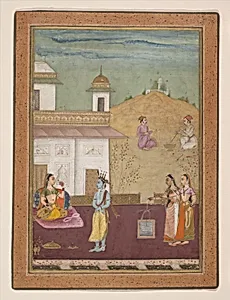
Medium
Ink, opaque watercolor, gold and silver on paper
Dimensions
Image: 7 3/8 × 5 1/8 in. (18.7 × 13 cm) Sheet: 8 1/2 × 6 3/8 in. (21.6 × 16.2 cm)
Classification
Paintings
Culture
India (Rajasthan, Bikaner)
Department
Asian Art
Museum
Metropolitan Museum of Art, New York, NY
Credit
Gift of Wendy Findlay, 1981
Accession Number
1981.371.1
Rights
Public Domain
Tags
Art Historical Context
This delicate page from a dispersed *Rasikap* (Lover's Breviary), painted by Nuruddin in 1685 in Bikaner, Rajasthan, captures the poetic essence of romantic love through the timeless figures of Radha and Krishna The *Rasikapriya*, a 16th-century text the poet Keshavdas, serves as a guide to the subtle moods and types of lovers and heroines in Hindi literature, often illustrated with divine couples from Krishna mythology. As part of a now-scattered manuscript, this folio reflects the Rajput courts' passion for such devotional and erotic themes during the late 17th century. Crafted in ink, opaque watercolor, gold, and silver on paper, the work exemplifies Bikaner painting's refined style, blending Mughal influences with local vibrancy. The compact image (7⅜ × 5⅛ in.) brims with intricate details—flowing garments, expressive faces, and shimmering metallic accents—that heighten the emotional intimacy between Radha, the devoted heroine, and Krishna, the playful divine lover. Housed in the Metropolitan Museum of Art's Asian Art Department since a 1981 gift, this piece highlights Rajasthan's artistic golden age, where painting bridged poetry, bhakti devotion, and courtly romance, inviting viewers to ponder love's many faces.