
page from the Holy Bible in Bohemian
published 1506
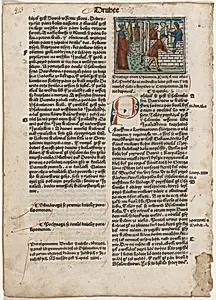
Medium
hand-colored woodcut
Dimensions
image: 6.03 × 7.46 cm (2 3/8 × 2 15/16 in.) sheet: 31.43 × 22.38 cm (12 3/8 × 8 13/16 in.)
Classification
Department
CG-E
Museum
National Gallery of Art, Washington, D.C.
Credit
Reba and Dave Williams Collection, Gift of Reba and Dave Williams
Accession Number
2008.115.3177
Rights
Public Domain
Art Historical Context
This charming hand-colored woodcut, titled *Page from the Holy Bible in Bohemian*, dates to 1506 and exemplifies the dawn of the printing revolution in Central Europe. Produced just after the incunabula period, it features a petite image (just 6 x 7 cm) nestled on a larger sheet, likely extracted from an early edition of the Bible translated into Czech, Bohemia’s vernacular tongue. Attributed to an Italian artist active in the early 16th century, it bridges Italian Renaissance influences with local printing traditions, showcasing how artistic ideas traveled across borders via the new technology of movable type. Woodcuts like this were the workhorses of early book illustration—carved into wooden blocks, inked, and pressed onto paper for mass production. The vibrant hand-coloring, applied post-printing, elevated humble prints into treasures for wealthy patrons, adding lifelike depth and devotional appeal. In a time when Bibles were mostly in Latin, this Bohemian page democratized scripture, fostering literacy and piety among everyday readers amid rising calls for vernacular worship. Housed in the National Gallery of Art’s Reba and Dave Williams Collection, this print whispers of cultural exchange and innovation, reminding us how a single illuminated page could spark spiritual and intellectual fires in 16th-century Europe.
About the Artist
Italian 16th Century · 1500–1599
"Italian 16th Century" refers to a collective attribution for anonymous painters and sculptors active in Italy during the 16th century, a period bridging the High Renaissance and Mannerism. These artists, often working in workshops of masters like Titian, Veronese, and Tintoretto, remain unidentified due to the collaborative nature of Renaissance production. Their early lives and training are not ...