
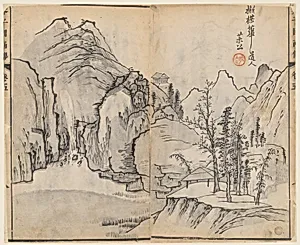
清 王槩繪圖、李漁出版 《芥子園畫傳》 木版畫|Page from the Mustard Seed Garden Manual of Painting
first edition, printed 1679
Medium
Woodblock print; ink and color on paper
Dimensions
9 5/8 x 11 13/16 in. (24.4 x 30 cm)
Classification
Prints
Culture & Period
China · Qing dynasty (1644–1911
Department
Asian Art
Museum
Metropolitan Museum of Art, New York, NY
Credit
Rogers Fund, 1924
Accession Number
CP12
Rights
Public Domain
Tags
About this artwork
This Woodblock print; ink and color on paper by Wang Gai from first edition, printed 1679 exemplifies historical artistic production through its materials, techniques, and aesthetic approach. Created within specific cultural and historical contexts, works like this reflect both individual artistic vision and broader patterns of workshop practice, patron expectations, and prevailing aesthetic theories. The medium of Woodblock print; ink and color on paper required specialized knowledge developed ...
Art Historical Context
This woodblock print comes from the first edition of the Mustard Seed Garden Manual of Painting, published in 1679 during China’s Qing dynasty. Illustrated by Wang Gai and issued by the noted scholar and publisher Li Yu, the manual became one of the most influential painting handbooks in East Asia. Its pages offered step-by-step guidance on brushwork, composition, and color for aspiring artists, helping to standardize and spread classical techniques across generations. The medium itself—ink and color printed from carved woodblocks—reflects a sophisticated printing tradition that allowed detailed images to be reproduced affordably and widely. Each block was cut with remarkable precision so that delicate lines and subtle washes could be transferred onto paper, making sophisticated landscape instruction available far beyond elite studios. Today the manual is valued both as an art object and as a window into seventeenth-century Chinese ideas about nature, learning, and artistic practice. Its landscape studies continue to inspire viewers with their balance of technical clarity and poetic suggestion.
About the Artist
Wang Gai · 1645–1710
Wang Gai (王概, 1645–1710), a prominent Qing dynasty painter from Xiushui in Zhejiang province, established himself in the vibrant cultural hub of Nanjing, where he flourished from around 1677 to 1705. Born into a scholarly family—his father-in-law was the renowned writer Li Yu (1611–1680)—Gai trained under the master Gong Xian (1619–1689), one of the Eight Masters of Jinling, adopting his robust la...