
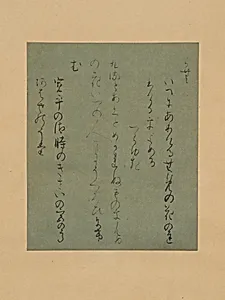
伝藤原行筆 「関戸本古今集切」|Page from the Sekido-bon Version of the “Collection of Poems Ancient and Modern” (Sekido-bon Kokinshū
mid- to late 11th century
Medium
Page from a bound booklet mounted as a hanging scroll; ink on dyed paper
Dimensions
Image: 8 3/8 × 6 7/8 in. (21.3 × 17.5 cm) Overall with mounting: 54 1/2 × 15 3/4 in. (138.5 × 40 cm) Overall with knobs: 54 1/2 × 17 3/4 in. (138.4 × 45.1 cm)
Classification
Calligraphy
Culture & Period
Japan · Heian period (794–1185)
Department
Asian Art
Museum
Metropolitan Museum of Art, New York, NY
Credit
Mary and Cheney Cowles Collection, Gift of Mary and Cheney Cowles, 2020
Accession Number
2020.396.1
Rights
Public Domain
Art Historical Context
This exquisite page from the Sekido-bon Kokinshū, attributed to the renowned calligrapher Fujiwara no Yukinari (972–1027), offers a rare glimpse into the refined aesthetics of Japan’s Heian period. Created in the mid- to late 11th century, it preserves verses from the Kokin wakashū, the first imperially commissioned anthology of waka poetry compiled in 905. Fujiwara no Yukinari, one of the “Three Brush Traces” (Sanseki), helped define the elegant Japanese style of calligraphy that moved away from Chinese models toward fluid, expressive forms suited to the native language. The work’s medium—ink brushed on delicately dyed paper—highlights the period’s sophisticated attention to materials and atmosphere. Originally part of a bound booklet, this sheet was later remounted as a hanging scroll, a transformation that allows modern viewers to appreciate its intimate scale and rhythmic brushwork in a new light. The soft color of the paper and the graceful variation in line thickness create a sense of quiet movement, mirroring the emotional subtlety prized in Heian court poetry. As a masterpiece of Japanese calligraphy, this fragment embodies the deep cultural connection between literature and visual art during the Heian era, when courtiers expressed their sensibilities through both verse and brush. Its presence in the Metropolitan Museum’s collection invites visitors to experience the refined elegance that shaped centuries of Japanese artistic tradition.