
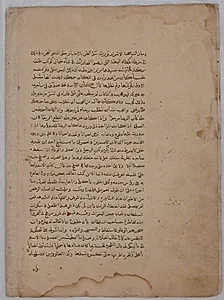
Page of Calligraphy from a Kalila wa Dimna
Unknown Artist
second quarter 16th century
Medium
Ink and opaque watercolor on paper
Dimensions
Overall: H. 12 1/2 in. (31.8 cm) W. 8 7/8 in. (22.6 cm) Average text size: H. 8 5/8 in. (21.9 cm) W. 4 7/8 in. (12.4 cm)
Classification
Codices
Department
Islamic Art
Museum
Metropolitan Museum of Art, New York, NY
Credit
The Alice and Nasli Heeramaneck Collection, Gift of Alice Heeramaneck, 1981
Accession Number
1981.373.38
Rights
Public Domain
Tags
Art Historical Context
This exquisite page of Arabic calligraphy hails from a 16th-century manuscript ofKalila wa Dimna a timeless collection of animal fables adapted from ancient Indian tales like the Panchatantra.inating in the second quarter of the 1500s—likely during the Safavid in Persia—these stories served as moral lessons for rulers and courtiers, blending wisdom with wit through anthropomorphic animals. As part of a codex in the Metropolitan Museum of Art's Islamic collection, this leaf (31.8 x 22.6 cm) exemplifies the pinnacle of manuscript production in the Islamic world. Rendered in flowing ink with touches of opaque watercolor on paper, the script showcases masterful naskh or muhaqqaq styles, where letterforms dance in harmonious rhythm. Calligraphy was revered as the noblest art in Islamic culture, embodying spiritual devotion and intellectual prowess; scribes often spent years perfecting their craft. The precise dimensions of the text block (21.9 x 12.4 cm) highlight the meticulous layout, ensuring readability and aesthetic balance. A gift from the Alice and Nasli Heeramaneck Collection in 1981, this page invites visitors to appreciate how such works preserved literature across empires, bridging Persian, Arabic, and broader Eurasian traditions. Gaze closely to feel the scribe's devotion etched in every curve.