
Page of Calligraphy from a Shahnama (Book of Kings)
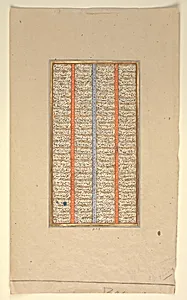
Medium
Ink, opaque watercolor, and gold on paper
Classification
Codices
Department
Islamic Art
Museum
Metropolitan Museum of Art, New York, NY
Credit
Purchase, Joseph Pulitzer Bequest, 1952
Accession Number
52.20.9c
Rights
Public Domain
Tags
Art Historical Context
Behold this stunning page of calligraphy from a *Shahnama* (Book of Kings), the monumental Persian epic composed by Ferdowsi around 1010 CE. Crafted between 1562 and 1583 in Shiraz during the Safavid—a golden age for Persian arts—this folio captures the rhythmic beauty of epic poetry recounting Iran's mythical kings, heroes, and battles. As part of a grand codex, it exemplifies the Islamic manuscript tradition where text and illumination merged to preserve oral histories in lavish, portable form. Renowned calligrapher and illuminator Muhammad ibn Taj al-Din Haidar Muzahhib Shirazi executed this work using ink for fluid nasta'liq script—the elegant, cursive style favored in Persian poetry—enhanced by opaque watercolors and shimmering gold. These techniques created a luminous surface, with intricate borders and motifs that drew the eye like a jeweled treasure, reflecting Shiraz's reputation as a hub for book production. Housed in the Metropolitan Museum of Art's Islamic Art Department (acquired through the Joseph Pulitzer Bequest in 1952), this page invites visitors to marvel at how calligraphy elevated literature into high art, embodying cultural pride and spiritual devotion in Safavid Iran.