
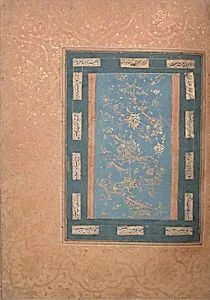
Page of Calligraphy from the Bellini Album
Unknown Artist
ca. 1600
Medium
Ink, opaque watercolor, and gold on paper
Dimensions
Painting: H. 8 3/8 in. (21.3 cm) W. 4 3/8 in. (11.1 cm) Page: H. 17 7/8 in. (45.4 cm) W. 12 5/8 in. (32.1 cm) Binding: H. 18 3/16 in. (46.2 cm) W. 13 7/8 in. (35.2 cm) D. 7/8 in. (2.2 cm)
Classification
Codices
Department
Islamic Art
Museum
Metropolitan Museum of Art, New York, NY
Credit
Louis V. Bell Fund, 1967
Accession Number
67.266.7.6v
Rights
Public Domain
Tags
Art Historical Context
This exquisite *Page of Calligraphy from Bellini Album*, created around 1600 by an unknown, exemplifies the pinnacle of Islamic artistic tradition. Crafted with ink, opaque watercolor, and gold on paper, folio measures about 17⅞ by 12⅝ inches as a full page, originally part of a bound album (18¼ by 13⅞ inches when closed). Housed in the Metropolitan Museum of Art's Islamic Department, it was acquired through the Louis V. Bell in 1967. Such albums were prized collections of loose folios, compiling masterful calligraphy and miniatures from across the Persianate world, likely Safavid Iran during a golden age of manuscript arts. In Islamic culture, calligraphy held supreme status as the most noble art form, often surpassing painting due to religious sensitivities around imagery. This page showcases virtuoso script—possibly nastaʿlīq, the flowing cursive style favored in poetry—rendered with precise ink strokes for rhythm and grace. Gold accents and vibrant opaque watercolors (gouache) illuminate the composition, creating a luminous effect that evokes spiritual devotion and poetic elegance. These techniques demanded years of training, transforming words from the Quran, Sufi verse, or Persian classics into visual harmony. Visitors to the Met will appreciate how this codex page captures the album's eclectic beauty, blending artistry with cultural reverence. It's a window into 17th-century elite patronage, where such treasures were treasured as symbols of refinement and faith.