
Pagus Nemorosus (Wooded Village)
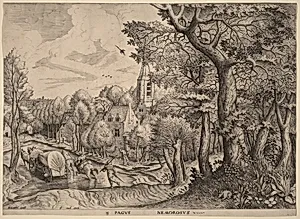
Medium
etching and engraving on laid paper
Dimensions
sheet (trimmed within plate): 30.7 × 42 cm (12 1/16 × 16 9/16 in.)
Classification
Department
CG-E
Museum
National Gallery of Art, Washington, D.C.
Credit
Rosenwald Collection
Accession Number
1964.8.419
Rights
Public Domain
Art Historical Context
Welcome to the National Gallery of Art, where *Pagus NemorosusWooded Village)* captivates with its intricate depiction of a lush, forested hamlet. Created around 1555–1557, this print is an etching and engraving on laid paper by master engravers Johannes and Lucas van Doetech, faithfully reproducing a design by Pieter Bruegel the Elder the renowned Flemish artist of the Northern Renaissance. Measuring about 30.7 × 42 cm, it showcases Bruegel's masterful ability to blend detailed human activity with expansive natural landscapes, evoking the everyday life of 16th-century rural Europe. Bruegel, celebrated for his innovative genre scenes and panoramic views, pioneered a new realism in landscape art during the Renaissance, moving beyond idealized Italianate vistas to capture the rugged beauty of his homeland. The van Doetechum brothers, prolific collaborators with Bruegel, transformed his drawings into highly detailed prints using fine etching for fluid lines and engraving for precise textures—techniques that allowed these works to reach collectors far beyond Antwerp's workshops. This reproductive print democratized Bruegel's vision, influencing generations of artists. As part of the esteemed Rosenwald Collection, *Pagus Nemorosus* highlights printmaking's cultural role in the 16th century, bridging elite patronage and public appreciation. Gaze closely at the teeming village nestled in dense woods, and you'll sense Bruegel's wry humanity amid nature's grandeur—a timeless invitation to wander through history.
About the Artist
Johannes and Lucas van Doetechum after Pieter Bruegel the Elder
Johannes van Doetechum the Elder (c. 1528/1532–1605) and his brother Lucas van Doetechum (active 1554–1572, died before 1589) were pioneering Netherlandish engravers based in Antwerp, renowned for their collaborative reproductive prints that faithfully captured the inventive designs of leading artists. Born in Deventer, the brothers honed their craft in the bustling Antwerp print workshops, workin...