
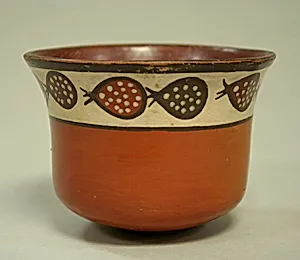
Painted Jar
Unknown Artist
1st–6th century
Medium
Ceramic, pigment
Dimensions
H. 2 3/4 × Diam. 3 7/8 in. (7 × 9.8 cm)
Classification
Ceramics-Containers
Culture
Nasca
Department
Arts of Africa, Oceania, and the Americas
Museum
Metropolitan Museum of Art, New York, NY
Credit
Gift of Mr. and Mrs. Jack Davis Neal, 1970
Accession Number
1970.245.5
Rights
Public Domain
Art Historical Context
This delicate Painted Jar, crafted by an unknown Nasca artist between the 1st and 6th centuries CE, exemplifies the masterful ceramics of the Nasca culture from ancient Peru's south coast. The Nas people, flourishing in the arid Nazca Valley, were renowned for their vibrant pottery traditions, which served both everyday and ritual purposes. Standing just 2¾ inches tall with a 3⅞-inch diameter, this small highlights the Nasca's skill in producing finely proportioned vessels despite their modest scale. Created from ceramic with post-fire pigments applied as slips, the jar showcases the Nasca's innovative polychrome technique. Artists mixed mineral pigments to achieve rich reds, yellows, blacks, and whites, firing them at low temperatures to create glossy, durable surfaces often adorned with motifs of animals, plants, or mythical beings—though the specific designs here evoke the culture's deep connection to nature and cosmology. These pots were not merely functional but artistic expressions of spiritual beliefs, possibly linked to agricultural fertility rites amid the desert environment. Today, this jar resides in the Metropolitan Museum of Art's Department of the Arts of Africa, Oceania, and the Americas, a generous gift from Mr. and Mrs. Jack Davis Neal in 1970. It invites us to marvel at the Nasca's enduring legacy in ceramics, bridging utility and artistry across millennia.