
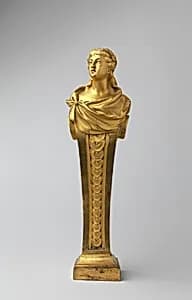
Pair of caryatids
Unknown Artist
18th century
Medium
Gilt bronze
Dimensions
Overall (.a confirmed): 8 1/8 x 2 1/8 x 1 3/8 in. (20.6 x 5.4 x 3.5 cm); Overall (.b confirmed): 8 1/8 x 2 3/8 x 1 1/2 in. (20.6 x 6 x 3.8 cm)
Classification
Metalwork-Gilt Bronze
Culture
French
Department
European Sculpture and Decorative Arts
Museum
Metropolitan Museum of Art, New York, NY
Credit
Gift of J. Pierpont Morgan, 1906
Accession Number
07.225.510.317a, b
Rights
Public Domain
Tags
Art Historical Context
This exquisite pair of gilt bronze caryatids crafted in 18th-century France by an unknown artist, embodies the era's fascination with classical antiquity. Standing just over 8 inches tall these graceful female figures—sculpted as architectural supports with flowing drapery and poised stances—were likely designed as decorative mounts for furniture, clocks, or candelabra. Their subtle size differences (.a at 8 1/8 x 2 1/8 x 1 3/8 in.; .b at 8 1/8 x 2 3/8 x 1 1/2 in.) suggest they formed a harmonious pair, evoking the ancient Greek prototypes from which caryatids derive their name, honoring the maidens of Karyai. Gilt bronze, a hallmark of French luxury decorative arts during the Louis XV and XVI periods, combined intricate lost-wax casting with fire gilding—a technique applying mercury-gold amalgam and heat for a radiant, durable finish. This opulent medium elevated everyday objects into symbols of refined taste, blending Rococo elegance with emerging Neoclassical restraint. A generous gift to the Metropolitan Museum of Art from J. Pierpont Morgan in 1906, these caryatids highlight France's enduring legacy in metalwork, inviting visitors to appreciate how 18th-century artisans revived antiquity to adorn aristocratic interiors with timeless poise and shimmering allure.