
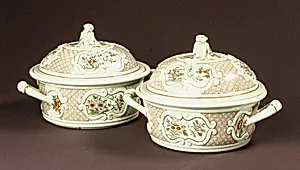
Pair of covered tureens
Medium
Hard-paste porcelain
Dimensions
Height (each): 6 in. (15.2 cm)
Classification
Ceramics-Porcelain
Culture
Austrian, Vienna
Department
European Sculpture and Decorative Arts
Museum
Metropolitan Museum of Art, New York, NY
Credit
The Jack and Belle Linsky Collection, 1982
Accession Number
1982.60.246a, b, .247a, b
Rights
Public Domain
Tags
Art Historical Context
This exquisite pair of covered tureens crafted around 1725 during the Claudius Innocentius du Paquier period at Vienna's pioneering porcelain manufactory, exemplifies early European mastery of hard-paste porcelain Founded in 1718 by entrepreneur du Paquier, the factory was Austria's first to produce this durable, translucent material—long a guarded secret of Chinese potters—rivaling Saxony's Meissen wares. Standing just 6 inches tall, these tureens served as luxurious vessels for soups or stews, blending functionality with opulent display for aristocratic tables. Adorned with playful monkeys amid blooming flowers, the tureens showcase the period's whimsical motifs, painted in vibrant overglaze enamels and likely gilded for added splendor. Hard-paste porcelain allowed for finer detailing and strength compared to softer varieties, enabling intricate modeling of lids topped with finials—perhaps monkey figures themselves—reflecting a fusion of exotic inspiration and emerging Rococo exuberance. Housed in The Metropolitan Museum of Art's European Sculpture and Decorative Arts department as part of The Jack and Belle Linsky Collection (1982), these pieces highlight Vienna's brief but brilliant role in the 18th-century "porcelain fever." They offer a window into the cultural prestige of tableware, where everyday dining became a canvas for artistic innovation and imperial ambition.