
Pair of Ear Ornaments with Green Stones
Unknown Artist
second half of the 8th–second half of the 10th century
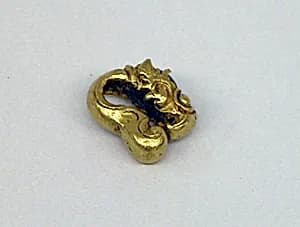
Medium
Gold with green stones
Dimensions
H. 1/16 in. (0.1 cm) (a): Diam. 1/2 in. (1.3 cm) (b): Diam. 1/2 in. (1.3 cm)
Classification
Jewelry
Culture & Period
Indonesia (Java) · Central Javanese period
Department
Asian Art
Museum
Metropolitan Museum of Art, New York, NY
Credit
The Samuel Eilenberg-Jonathan P. Rosen Collection of Indonesian Gold, Bequest of Samuel Eilenberg and Gift of Jonathan P. Rosen, 1998
Accession Number
1998.544.129a, b
Rights
Public Domain
Art Historical Context
These delicate **Pair of Ear Ornaments with Green Stones** hail from Java, Indonesia, during the Central Javanese period (second half of the 8th–second half of the 10th century). Crafted from gold inlaid with vibrant green stones, they measure just 0.1 cm in height and 1.3 cm in diameter—tiny marvels that highlight the extraordinary finesse of ancient Javanese goldsmiths. Part of **The Samuel Eilenberg-Jonathan P. Rosen Collection** at The Metropolitan Museum of Art, they exemplify elite jewelry from a time when powerful Hindu-Buddhist kingdoms like the Sailendras and Matarams flourished, building monumental temples such as Borobudur and Prambanan. In this era, gold was a prized symbol of wealth and status, sourced through extensive trade networks spanning India, China, and Southeast Asia. The ornaments' intricate design and use of green stones—likely valued for their rarity and symbolic associations with fertility or divinity—reflect advanced metallurgical techniques, including fine hammering and stone-setting. Worn by nobility or in ceremonial contexts, such pieces adorned the body as extensions of spiritual and social power. Today, these earrings offer a glimpse into Java's artistic golden age, where personal adornment intertwined with cosmology and kingship. Their preservation underscores the enduring allure of ancient craftsmanship.