
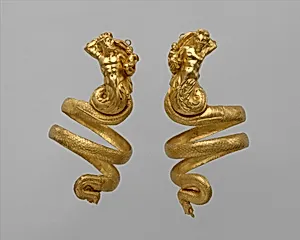
Pair of gold armbands
Unknown Artist
ca. 200 BCE
Medium
Gold
Dimensions
Overall: 10 7/16in., 0.4lb. (26.5cm, 0.2kg) Other (height-triton armband): 9 13/16in. (25cm) Other (height-tritoness armband): 10 7/16in. (26.5cm)
Classification
Gold and Silver
Culture & Period
Greek · Hellenistic
Department
Greek and Roman Art
Museum
Metropolitan Museum of Art, New York, NY
Credit
Rogers Fund, 1956
Accession Number
56.11.5, .6
Rights
Public Domain
Tags
Art Historical Context
This exquisite pair of gold armbands dating to around 200 BCE, hails from the Hellenistic period of ancient Greece—a time of artistic exuberance following Alexander the Great's conquest. Crafted from pure gold, they measure about 10 inches in height and weigh a delicate 0.4 pounds total, with one armband featuring a Triton (male sea deity) at 9 13/16 inches and its counterpart a Tritoness (female counterpart) slightly taller at 10 7/16 inches. Now housed in the Metropolitan Museum of Art's Greek and Roman Art Department, thanks to the Rogers Fund of 1956, these jewels showcase the era's mastery of fine metalwork. Hellenistic goldsmiths favored mythological motifs like Triton, the fish-tailed son of Poseidon, and Eros, the god of love, often blending them in dynamic scenes of sea fantasy and desire. These armbands likely served as status symbols for elite women, adorning the upper arm in a culture where jewelry reflected wealth and divine favor. The lightweight yet lavish gold underscores the technical prowess of repoussé hammering and chasing techniques, creating fluid figures that evoke the period's emotional intensity and realism. Imagine slipping these on during a symposium or festival—their gleaming surfaces catching torchlight, whispering tales of the sea's wild beauty. A testament to Hellenistic innovation, they bridge everyday adornment and eternal myth.