
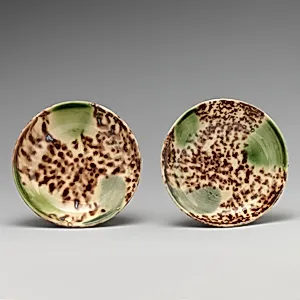
Pair of miniature dishes
ca. 1760
Medium
Lead-glazed earthenware
Dimensions
Each: 3/4 × 3 3/16 in. (1.9 × 8.1 cm)
Classification
Ceramics-Pottery
Culture
British, Staffordshire
Department
European Sculpture and Decorative Arts
Museum
Metropolitan Museum of Art, New York, NY
Credit
Gift of Dr. and Mrs. A. L. Garbat, 1961
Accession Number
61.107.119, .120
Rights
Public Domain
Art Historical Context
These exquisite pair of miniature dishes, in the "Whieldon type" 1760, hail from the bustling potteries of Staffordshire, England cradle of British ceramic innovation during the Georgian era. Thomas Whieldon, a potter active in the mid-18th century, his name to this distinctive style of lead-glazed earthenware, for its vibrant, mottled glazes that mimicked pricier porcelain or Oriental wares. At just 3/4 × 3 3/16 inches each, these delicate pieces showcase the miniaturist's art, likely intended for dollhouses, children's toys, or ornamental displays, blending whimsy with technical prowess. The lead glaze technique was revolutionary, firing earthenware clay at low temperatures to yield a glossy, durable surface often swirled in tortoiseshell-like patterns of cream, green, and brown. Staffordshire factories like Whieldon's produced affordable luxuries for the growing middle class, paving the way for giants like Wedgwood. These dishes exemplify how everyday ceramics became miniature marvels of color and form, reflecting Britain's industrial creativity. A generous gift to the Metropolitan Museum of Art in 1961 from Dr. and Mrs. A. L. Garbat, they invite visitors to ponder the charm of 18th-century domesticity in pocket-sized perfection.
About the Artist
Whieldon type
Whieldon-type is not a single artist but a catalogue attribution used by museums for unmarked mid-18th-century Staffordshire earthenware in the manner of Thomas Whieldon (1719-1795), the celebrated English potter of Fenton Vivian. Whieldon perfected lead-glazed cream-colored earthenware streaked and dappled with metallic oxides - manganese browns, copper greens, cobalt blues - producing the mottle...