
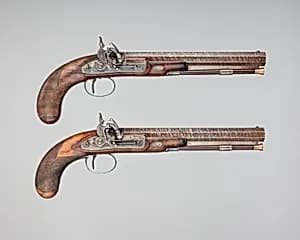
Pair of Pellet-Lock Pistols with Case with Accessories
ca. 1825
Medium
pistols: steel, wood (walnut), platinum, brass; case: wood (mahogany), textile, brass, bone, paper; powder flask: brass; bullet mold: steel; nipple wrench: wood (mahogany?), brass, steel; ramrod: wood (mahogany?), bronze, steel; spare nipples: steel; spare firing pins: steel
Dimensions
Pistol (a); L. 14 15/16 in. (37.9 cm); L. of barrel 9 3/4 in. (24.8 cm); Cal. .56 in. (14.2 mm); Wt. 2 lb. 3.2 oz. (997.9 g); pistol (b); L. 15 in. (38.1 cm); L. of barrel 9 3/4 in. (24.8 cm); Cal. .57 in. (14.5 mm); Wt. 2 lb. 2.6 oz. (980.9 g); powder flask (c); H. 4 7/8 in. (12.4 cm); Wt. 5.4 oz. (153.1 g); bullet mould (d); L. 5 1/2 in. (14 cm); Wt. 2.6 oz. (73.7 g); ramrod (e); L. 5 1/2 in. (14 cm); Wt. 1 oz. (28.3 g); nipple wrench (f); L. 6 in. (15.2 cm); Wt. 2.2 oz. (62.4 g); case (g); H. 2 5/8 in. (6.7 cm); W. 11 in. (27.9 cm); D. 8 3/4 in. (22.2 cm); Wt. 5 lb. 4.2 oz. (2387 g)
Classification
Firearms-Pistols
Culture
British, London
Department
Arms and Armor
Museum
Metropolitan Museum of Art, New York, NY
Credit
Gift of Charles M. Schott Jr., 1917
Accession Number
19.53.108a–g
Rights
Public Domain
Art Historical Context
Step into the Arms and Armor gallery to admire this exquisite *Pair of Pellet-Lock Pistols with and Accessories*, crafted by London gunsmith Charles Moore around 1825. These masterpieces represent the pinnacle of early 19th-century firearm, blending lethal functionality with elegant craftsmanship. Measuring about 15 inches long with .56- to .57-inch calibers, the pistols feature barrels of finely worked steel, walnut stocks for a comfortable grip, and accents of platinum and brass that highlight their status as luxury items for discerning gentlemen—likely for dueling, hunting, or sport. The pellet-lock mechanism was a clever innovation of the era, using pre-measured powder pellets ignited by a flint or early percussion system, bridging the gap between flintlocks and the more reliable percussion caps that soon followed. This transitional technology marked a key evolution in firearms during the post-Napoleonic period, improving reliability over loose powder while showcasing Moore's precision engineering. The accompanying mahogany case, lined in textile and fitted with brass, bone, and paper elements, houses essential tools: a brass powder flask, steel bullet mold, nipple wrench, ramrod, and spare parts, forming a complete gentleman's toolkit. Generously gifted to the Metropolitan Museum of Art in 1917 by Charles M. Schott Jr., this set exemplifies British gunmaking artistry—where form met function in an age of industrial innovation and imperial adventure. A true testament to Regency-era ingenuity!