
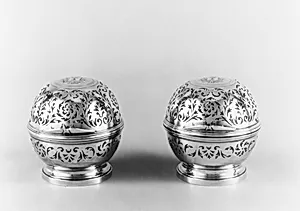
Pair of sponge boxes
Medium
Silver
Dimensions
Overall (each): 3 3/8 × 3 1/2 in. (8.6 × 8.9 cm)
Classification
Metalwork-Silver
Culture
French, Paris
Department
European Sculpture and Decorative Arts
Museum
Metropolitan Museum of Art, New York, NY
Credit
Bequest of Catherine D. Wentworth, 1948
Accession Number
48.187.96, .97
Rights
Public Domain
Art Historical Context
Crafted in 1775 by Parisian silversmith Claude-Pierreville, this exquisite *Pair of Sponge Boxes* exemplifies the refined metalwork of late 18th-century France. Measuring just 3⅜ × 3½ inches each, these petite silver containers were designed to hold sponges for personal grooming rituals, a luxurious accessory in the toilettes of the French aristocracy during the waning years of the Ancien Régime. Deville, active in Paris's prestigious guild of silversmiths, marked his works with the city's distinctive poinçons, ensuring authenticity and quality. Silver was the medium of choice for such intimate objects, prized for its luster, malleability, and status as a precious metal that rivaled gold in opulence. These boxes reflect the transition from ornate Rococo to emerging Neoclassicism, showcasing the silversmith's mastery in shaping, chasing, and possibly engraving to create functional yet elegant forms. Produced on the eve of the French Revolution, they capture a moment of extravagant refinement amid social upheaval. Today, housed in the Metropolitan Museum of Art's Department of European Sculpture and Decorative Arts through the 1948 bequest of Catherine D. Wentworth, this pair invites us to glimpse the daily elegance of pre-revolutionary elite life. A testament to Parisian craftsmanship, they remind us how even the smallest artifacts embody cultural splendor.