
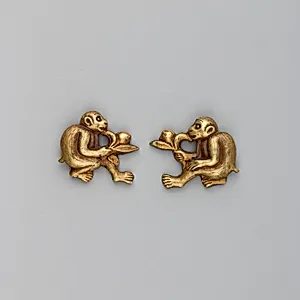
Pair of Sword-Grip Ornaments (Menuki)
Unknown Artist
early–mid-17th century
Medium
Gold
Dimensions
L. of each 3/4 in. (1.9 cm); Wt. of each 0.1 oz. (2.8 g)
Classification
Sword Furniture-Menuki
Culture
Japanese
Department
Arms and Armor
Museum
Metropolitan Museum of Art, New York, NY
Credit
Purchase, Joseph Pulitzer Bequest, 1938
Accession Number
38.55.73a, b
Rights
Public Domain
Tags
Art Historical Context
This exquisite pair of gold menuki or sword-grip ornaments, hails from Japan in the early to mid-17th century during the early Edo period when samurai culture flourished. Crafted as functional yet decorative elements for katana hilts, menuki were slipped beneath the ray-skin and silk wrapping of the tsuka (handle) to enhance grip and add subtle artistry visible only upon unwrapping. Measuring just 3/4 inch long and weighing a mere 0.1 ounce each, these diminutive treasures showcase the Japanese metalworkers' mastery of precision and luxury in arms and armor. Depicting playful monkeys—a motif symbolizing wit and mischief in Japanese folklore—these ornaments highlight the era's fascination with nature-inspired designs in sword fittings. Hammered and intricately detailed in pure gold, they reflect advanced techniques like chasing and repoussé, elevating everyday weaponry into wearable art. Acquired through the Joseph Pulitzer Bequest in 1938, they now grace the Metropolitan Museum of Art's Arms and Armor Department, offering visitors a glimpse into the refined aesthetics of feudal Japan. (198 words)