
Pair of Torah finials (rimonim)
ca. 1740–50
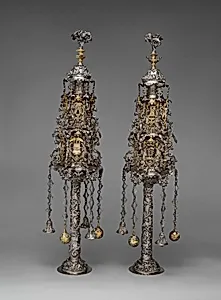
Medium
Parcel-gilt silver
Dimensions
Overall (.416 confirmed): 26 9/16 × 6 3/16 × 6 in., 90.965oz. (67.5 × 15.7 × 15.2 cm, 2579.1g); Overall (.417 confirmed): 26 11/16 × 6 × 6 in., 93.307oz. (67.8 × 15.2 × 15.2 cm, 2645.5g)
Classification
Metalwork-Silver
Culture
Italian, Venice
Department
European Sculpture and Decorative Arts
Museum
Metropolitan Museum of Art, New York, NY
Credit
Walter and Leonore Annenberg Acquisitions Endowment Fund, 2016
Accession Number
2016.416, .417
Rights
Public Domain
Art Historical Context
This exquisite pair of Torah finials or *rimonim*, crafted Venetian silversmith Andrea Zamb "L'Honnesta" around 1740–50, crowns the sacred Torah scrolls used in Jewish synagogue rituals. Standing over 26 inches tall and weighing nearly six pounds each, these parcel-gilt silver masterpieces exemplify the opulent metalwork of 18th Venice, where partial gilding—mercury-fire technique applying gold to silver surfaces—created a shimmering contrast of gleaming gold accents against polished silver, symbolizing divine radiance. Hailing from Italy's vibrant Jewish community in Venice, a hub of multicultural artistry during the Rococo era, these finials reflect the fusion of Christian silversmithing prowess with Jewish ceremonial tradition. *Rimonim* like these adorned the wooden Torah staves, rung gently during processions to honor the sacred text. Their intricate forms, likely featuring architectural motifs or floral designs typical of Venetian silver, highlight Zambelli's mastery in the European decorative arts tradition. Acquired in 2016 through the Walter and Leonore Annenberg Endowment, these finials now grace the Metropolitan Museum of Art's European Sculpture and Decorative Arts collection, offering visitors a tangible link to Venice's gilded age and enduring religious devotion.