
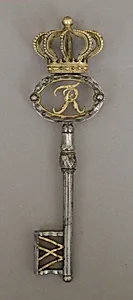
Palace key
Unknown Artist
late 18th–early 19th century
Medium
Steel, parcel-gilt
Dimensions
Length: 6 1/4 in. (15.9 cm)
Classification
Metalwork-Steel
Culture
German
Department
European Sculpture and Decorative Arts
Museum
Metropolitan Museum of Art, New York, NY
Credit
Rogers Fund, 1912
Accession Number
12.23.3
Rights
Public Domain
Art Historical Context
This exquisite "Palace key," by an unknown German artist in the late th to early 19th century exemplifies the fine metalwork traditions of Europe during a time of opulent palace culture. Measuring just 6 1/4 inches (15.9 cm) in, this steel key was likely used for ceremonial purposes in grand estates or royal residences, symbolizing authority and access to power. Its presence in the Metropolitan Museum of Art's Sculpture and Decorative Arts, acquired through the Rogers Fund in 1912, highlights its status as a treasured example of functional art elevated to decorative splendor. The key's medium—steel with parcel-gilt decoration—is particularly noteworthy. Parcel-gilding involved selectively applying thin sheets or mercury-gilt gold to the steel surface, creating shimmering accents that drew the eye to intricate motifs while preserving the metal's durability. This technique, popular in German metalwork, blended practicality with luxury, reflecting the era's neoclassical influences and the craftsmanship of specialized workshops. Such keys were not mere tools but status symbols, often gifted or displayed to convey prestige. Visitors will appreciate how this modest object opens a window into 18th- and 19th-century German society, where even everyday hardware became a canvas for artistry and hierarchy.