
Panel
c. 1720
Medium
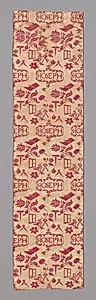
silk, satin weave with supplementary patterning wefts and self-patterned by areas of weft-float faced twill weave; two selvages present. Central cartouche with inscription surrounded by regularly placed carpenter's tools; say, compass, drill, plane, and mallet, in red on off-white ground
Dimensions
223.3 × 57.1 cm (87 7/8 × 22 1/2 in.); Repeat: 43.2 × 28 cm (17 × 11 in.)
Classification
textile
Department
Textiles
Museum
Art Institute of Chicago
Accession Number
74750
Rights
Public Domain
Art Historical Context
This exquisite silk panel, dating to around 1720, hails from the Art Institute of Chicago's Textiles collection. Measuring an impressive 223.3 × 57.1 cm, it a striking off-white ground adorned with vibrant red motifs: a central cartouche enclosing an inscription, encircled by an array of carpenter's tools including a saw, compass,, plane, and mal. The repeating pattern (43.2 28 cm) suggests it was woven for extended use, perhaps as a trade banner, curtain, or decorative hanging. Crafted in a sophisticated satin weave with supplementary patterning wefts and areas of weft-float faced twill, the textile showcases advanced 18th-century loom techniques. The presence of two selvages indicates it was produced directly from the loom without cutting, preserving its structural integrity. Such complex weaving, likely European in origin, highlights the era's mastery of silk production amid growing trade guilds. Occupational themes like these carpenter's tools often celebrated skilled artisans, reflecting the cultural pride in craftsmanship during the early Enlightenment. This panel offers a vivid glimpse into the social fabric of the time, where textiles doubled as symbols of profession and prestige, blending utility with artistry.
About the Artist
Unknown
The artist designated as "Unknown" in our virtual museum's collection exemplifies a poignant chapter in art history: creators whose identities have faded into obscurity despite the enduring power of their work. With only one known artwork attributed to them in our holdings, this figure represents countless anonymous hands that shaped visual culture across centuries. Museums worldwide, including th...