
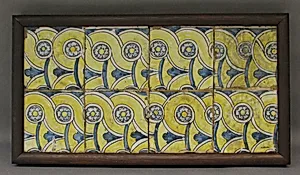
Panel of tiles (8)
Unknown Artist
ca. 1660
Medium
Faience (tin-glazed earthenware)
Dimensions
Overall: 10 × 20 in. (25.4 × 50.8 cm)
Classification
Ceramics-Pottery
Culture
French, Rouen
Department
European Sculpture and Decorative Arts
Museum
Metropolitan Museum of Art, New York, NY
Credit
Gift of J. Pierpont Morgan, 1917
Accession Number
17.190.1951
Rights
Public Domain
Art Historical Context
This exquisite panel of eight faience tiles, crafted in Rouen, France, around 1660, offers a glimpse into the opulent domestic life of 17th-century. Rouen was a thriving hub for faience production during Louis XIV's reign, renowned for its high-quality tin-glazed earthen that rivaled Italian maiolica. These compact tiles, measuring 10 × 20 inches overall, were likely designed for interior decoration—perhaps adorning a fireplace surround, wainscoting, or cabinetry—bringing vibrant color and pattern to bourgeois homes. Faience's tin-glazing technique created a smooth, glossy surface ideal for intricate designs, often featuring landscapes, figures, or floral motifs painted in rich blues, greens, and manganese purple. The opacity of the glaze protected the earthenware body while allowing bold, durable decoration that withstood daily use. Though the artist remains unknown, this panel exemplifies Rouen's mastery of the medium, blending functionality with artistry in the Baroque era's love for elaborate ornament. A generous gift from financier J. Pierpont Morgan in 1917, it now graces The Metropolitan Museum of Art's European Sculpture and Decorative Arts collection. For visitors, it evokes the tactile elegance of French craftsmanship, reminding us how everyday objects became canvases for cultural expression.