
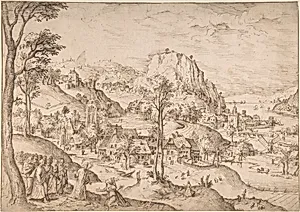
Panoramic Mountainous Estuary Landscape, with Christ and the Woman of Canaan
mid-16th century
Medium
Pen and brown ink
Dimensions
10-9/16 x 15-1/16 in. (26.8 x 38.3 cm)
Classification
Drawings
Department
Drawings and Prints
Museum
Metropolitan Museum of Art, New York, NY
Credit
Purchase, Anonymous Gift, in memory of Frits Markus, 2000
Accession Number
2000.120
Rights
Public Domain
Tags
Art Historical Context
In the mid-16th century, Netherlandish artist Lucas Gassel crafted this intricate pen and brown ink drawing, *Panoramic Mountainous Estuary Landscape, with Christ and the Woman of Canaan*. Measuring just over 10 by 15 inches, it exemplifies the emerging "world landscape" style, where expansive natural vistas dominate the composition. Gassel, active in Antwerp around 1530–1560, was among the early specialists in detailed panoramic views, blending biblical narratives with meticulously rendered topography. At the heart of the scene is the New Testament episode from Matthew 15, where Christ encounters the Canaanite woman pleading for her daughter's healing. Tiny figures of Christ, the woman, and scattered houses nestle amid towering mountains, a winding estuary, and lush trees, creating a sense of divine drama unfolding in an immense, almost fantastical world. This fusion of sacred story and secular landscape reflects the Northern Renaissance's growing fascination with nature as a reflective stage for human and spiritual events. Gassel's masterful use of pen and brown ink—employing fine lines, cross-hatching, and washes—brings texture and depth to the foliage, water, and rugged cliffs, showcasing the medium's precision for preparatory sketches or independent works. Acquired by the Metropolitan Museum of Art in 2000, this drawing highlights the technical innovation of 16th-century draftsmen, bridging religious iconography with the birth of landscape as an artistic genre.