
Paperweight
Unknown Artist
Medium
Nephrite, light spinach-green with black inclusions, and a light gray caused by calcination
Dimensions
H. 6 5/8 in. (16.9 cm); W. 2 1/16 in. (5.2 cm); D. 1 3/8 in. (3.5 cm)
Classification
Jade
Culture & Period
China · Qing dynasty (1644–1911), Qianlong period (1736–95)
Department
Asian Art
Museum
Metropolitan Museum of Art, New York, NY
Credit
Gift of Heber R. Bishop, 1902
Accession Number
02.18.714
Rights
Public Domain
Tags
Art Historical Context
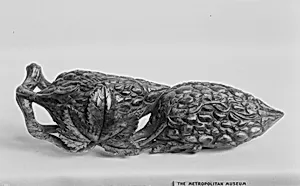
This elegant nephrite jade paperweight shaped as a cluster of gourds,ails from China's Qing dynasty during the Qianlong period (173–95), a golden age of imperial artistry. Carved from light spinach-green stone veined with black inclusions andented by light gray areas from calcination—a deliberate heating process that enhances color and texture—the piece stands 6⅝ inches tall. Its slender form (2 inches wide, 1⅜ inches deep) made it a perfect functional object for a scholar's desk, blending with refined beauty. In Chinese culture, jade has long symbolized purity, immortality, and moral virtue, with nephrite being the most revered variety for its toughness and translucency. Gourds, rendered here with masterful undercutting to suggest natural vines and leaves, carry auspicious meanings: longevity (due to their wrinkled skins evoking old age), prosperity (from abundant seeds), and even scholarly success. Qianlong emperor's workshops excelled in such intricate carvings, exploiting the stone's natural flaws to create lifelike effects, showcasing technical virtuosity. A gift to the Metropolitan Museum of Art from Heber R. Bishop in 1902, this paperweight exemplifies the opulence of 18th-century Chinese jade artistry, inviting visitors to appreciate its tactile allure and cultural depth.