
Paperweight
c. 1845–60
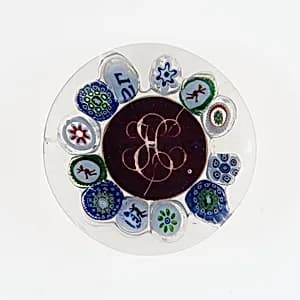
Medium
Glass
Dimensions
Diam.: 5.1 cm (2 in.)
Classification
paperweight
Department
Applied Arts of Europe
Museum
Art Institute of Chicago
Accession Number
187966
Rights
Public Domain
Art Historical Context
This exquisite glass paperweight, crafted by the renowned Compagnie de Saint-Louis around 1845–60, exemplifies the pinnacle of 19th-century French glassmaking. Measuring just 2 inches in diameter, this diminutive object from the Art Institute of Chicago's Applied Arts of Europe collection was designed for the bourgeois writing desk, a symbol of refined taste amid the Industrial Revolution's rise in literacy and office culture. Saint-Louis, founded in 1767 in Lorraine, France, was one of Europe's oldest crystal manufacturers and a leader in the "golden age" of paperweights (circa 1840–65). Alongside rivals like Baccarat and Clichy, they pioneered intricate techniques such as millefiori (bundled glass canes forming flower-like patterns) and lampworking, encasing colorful motifs within clear domes to preserve their vibrancy. This period's innovations stemmed from advances in glass formulas and cutting tools, transforming functional items into collectible art. Today, Saint-Louis paperweights are prized for their technical mastery and whimsical designs, reflecting France's blend of utility and luxury. Held up to light, they reveal a sparkling microcosm of Victorian-era ingenuity, inviting visitors to ponder how such tiny treasures captured the era's spirit of innovation.
About the Artist
Compagnie de Saint Louis
**Compagnie des Cristalleries de Saint Louis**, founded in 1586 in Münzthal, Lorraine (present-day Saint-Louis-lès-Bitche, France), stands as the oldest glass manufacturer in France and the first to produce crystal glass on the continental European mainland starting in 1781.) Initially focused on window glass and bottles, the company shifted toward luxury crystal production in the 19th century. By...