
Papyrus fragment
Unknown Artist
4th century BCE–6th century CE or later
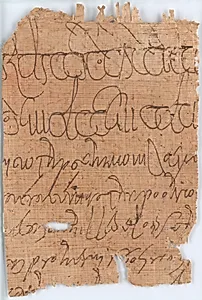
Medium
Papyrus, ink
Dimensions
Overall: 6 11/16 x 4 1/2 in. (17 x 11.4 cm) Framed: 7 1/2 x 5 1/2 in. (19.1 x 13.9 cm)
Classification
Papyrus
Culture
Egyptian
Department
Medieval Art
Museum
Metropolitan Museum of Art, New York, NY
Credit
Museum Accession
Accession Number
O.C.3557
Rights
Public Domain
Tags
Art Historical Context
This delicate papyrus fragment, hailing from ancient Egypt and dated broadly from the 4th century BCE the 6th century CE or later, offers a tantalizing glimpse into the scribal traditions of the Greco-Roman world. Crafted from the of the papyrus plant—a hallmark of Egyptian ingenuity—and inscribed with ink, it measures a modest 6 11/16 x 4 1/2 inches. Such fragments, preserved in the Metropolitan Museum of Art's Art department, survive thanks to Egypt's arid climate, which shielded them from decay that claimed most ancient writings elsewhere. The Greek tag hints at Hellenistic or Roman-era influences, when Greek script flourished alongside Egyptian culture under Ptolemaic and imperial rule. Ink, typically made from soot or charcoal mixed with gum arabic, was applied with reed pens in a precise, flowing hand, showcasing the era's advanced literacy. These scraps often held everyday texts—literary excerpts, contracts, or magical incantations—revealing the vibrancy of multicultural Egypt. As a cultural artifact, this fragment underscores papyrus's pivotal role in transmitting knowledge from Homer to early Christian works, bridging antiquity and the medieval world. Though incomplete, it invites us to ponder the voices of unnamed scribes whose words echo across millennia.