
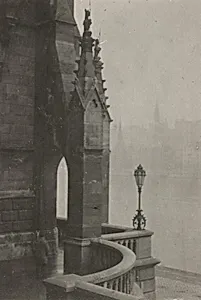
Parliament Building, Budapest
1919-1925
Medium
gelatin silver print
Dimensions
sheet (trimmed to image): 4.1 x 2.8 cm (1 5/8 x 1 1/8 in.)
Classification
Photograph
Department
CPH
Museum
National Gallery of Art, Washington, D.C.
Credit
Gift of The André and Elizabeth Kertész Foundation
Accession Number
1999.122.21
Rights
Public Domain
Art Historical Context
Behold the majestic *Parliament Building, Budapest*1919-1925), a intimate gelatin silver print by pioneering photographer André Kertész.ured during his early career in his native Hungary, this tiny image—measuring just 4.1 x 2.8 cm—evokes the grandeur of Budapest's iconic Gothic Revival landmark along the Danube. Completed amid the political upheaval following World War I and the dissolution of the Austro-Hungarian Empire, reflects Kertész's ability to distill monumental architecture into a personal, almost pocket-sized memento of home. Kertész, a modernist master who later revolutionized photography in Paris and New York, favored spontaneous compositions and geometric precision. Here, the gelatin silver process yields crisp tonal contrasts and fine details, hallmarks of early 20th-century printing that allowed for rich blacks and luminous highlights. The miniature scale adds whimsy, transforming a symbol of national power into something tender and portable. Now in the National Gallery of Art through a gift from The André and Elizabeth Kertész Foundation, this print invites visitors to ponder how Kertész's innovative gaze elevated everyday scenes—and grand edifices alike—into timeless art. A snapshot of history in your hand!
About the Artist
André Kertész · 1894–1985
André Kertész, born Andor Kertész on July 2, 1894, in Budapest, Hungary, to a middle-class Jewish family, initially pursued a conventional path as a clerk at the Budapest Stock Exchange after graduating from the Academy of Commerce in 1912. Self-taught in photography after purchasing his first camera that year, he captured his early poetic visions of Hungarian landscapes and peasant life, includin...