
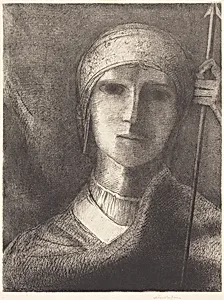
Parsifal
1892
Medium
lithograph
Classification
Department
CG-E
Museum
National Gallery of Art, Washington, D.C.
Credit
Rosenwald Collection
Accession Number
1954.12.180
Rights
Public Domain
Art Historical Context
Odilon Redon's *Parsifal* (1892), a lithograph from the National of Art's Rosenwald, draws inspiration from Richard Wagner's groundbreaking opera of the same name, premiered a decade earlier. Redon, a leading figure in French Symbolism, was deeply influenced by Wagner's mystical themes of redemption, purity, and the Holy Grail quest. This print captures the opera's ethereal spirit through Redon's signature dreamlike imagery, blending fantasy with subtle psychological depth. As one of Redon's "noirs"—his masterful black-and-white works from the 1870s to 1890s—the lithograph exemplifies his innovative use of the medium. Lithography allowed Redon to achieve soft, velvety tones and misty atmospheres with crayon and tusche on stone, evoking otherworldly visions that transcend mere illustration. Printed in an edition typical of his intimate series, it reflects the Symbolist movement's emphasis on suggestion over realism, inviting viewers into a realm of imagination and introspection. Housed in the National Gallery's Prints department (CG-E), *Parsifal* highlights Redon's pivotal role in bridging 19th-century Romanticism and modern abstraction, offering visitors a window into fin-de-siècle cultural fascination with myth and music.
About the Artist
Odilon Redon · 1840–1916
Odilon Redon (1840-1916) was a French Symbolist painter, printmaker, and pastellist whose visionary art bridged the 19th-century Symbolist movement and 20th-century Surrealism. Born Bertrand Redon in Bordeaux on April 20, 1840, he earned the nickname "Odilon" from his mother Odile. His father, who made his fortune in the Louisiana slave trade, conceived Odilon in New Orleans before the family retu...