
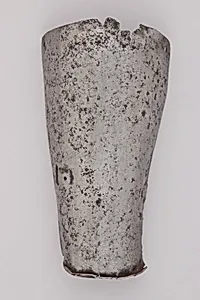
Part of a Forearm Defense (Vambrace)
Unknown Artist
ca. 1450–70
Medium
Steel
Dimensions
H. 8 1/2 in. (21.6 cm); W. 2 in. (5.1 cm); D. 4 1/2 in. (11.4 cm); Wt. 5.9 oz. (167.3 g)
Classification
Armor Parts
Culture
Italian
Department
Arms and Armor
Museum
Metropolitan Museum of Art, New York, NY
Credit
Bashford Dean Memorial Collection, Bequest of Bashford Dean, 1928
Accession Number
29.150.38
Rights
Public Domain
Art Historical Context
This elegant steel vambrace, or forearm defense, hails from Italy around 1450–70, a pivotal era bridging the late Middle Ages and the Renaissance. Crafted for a knight or man-at-arms, it formed part of a full suit of armor, protecting the lower arm during fierce combats or tournaments. At just 8½ inches high and a mere 5.9 ounces, its lightweight design highlights the Italian armorer's mastery in balancing robust defense with essential mobility on the battlefield. Italian armorers of this period were renowned for their innovative steelworking techniques, forging plates that were both resilient against blades and precisely shaped to the body's contours. This piece exemplifies the transition toward more articulated, form-fitting armor, influenced by evolving warfare tactics and the humanist ideals of the Renaissance, where even military gear reflected artistic refinement. Today, housed in the Metropolitan Museum of Art's Arms and Armor Department as part of the Bashford Dean Memorial Collection, this vambrace invites us to ponder the blend of artistry and survival in 15th-century Italy—a testament to craftsmanship that turned cold steel into wearable sculpture.