
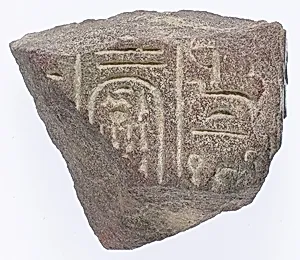
Part of a small block with name of Nefertiti and another on adjacent sides
Unknown Artist
ca. 1353–1336 B.C.
Medium
Red quartzite
Dimensions
H. 5 × W. 5.5 × D. 3.8 cm (1 15/16 × 2 3/16 × 1 1/2 in.); oriented from side with Nefertiti cartouche
Classification
Small block, name of Nefertiti
Period
New Kingdom, Amarna Period
Department
Egyptian Art
Museum
Metropolitan Museum of Art, New York, NY
Credit
Gift of Edward S. Harkness, 1921
Accession Number
21.9.7
Rights
Public Domain
Art Historical Context
This petite fragment of red quartzite, measuring just 5 cm high, hails from Egypt's Amarna Period (ca. 1353–1336 B.C.), a revolutionary era in the New Kingdom Dynasty 18. Carved during the reign of Akhenaten, it bears the royal cartouche of his famous queen, Nefertiti—whose iconic bust captivates museums worldwide—alongside another name on an adjacent side. Likely part of a larger architectural from a temple or palace at Akhenaten's new capital, Amarna, it exemplifies the period's bold shift toward monotheistic worship of the sun god Aten and innovative, naturalistic art styles. Red quartzite, a durable and vividly colored hardstone quarried from Egypt's eastern deserts, was prized for elite sculptures and inscriptions due to its resistance to weathering and symbolic resonance with divine power. The precise hieroglyphs within the cartouches, protected by an oval enclosure, highlight masterful stoneworking techniques, where artisans incised deep, clear lines to ensure legibility and permanence. Gifted to the Metropolitan Museum of Art in 1921 by Edward S. Harkness, this tiny treasure offers a tangible link to Nefertiti's enigmatic legacy, reminding us of Amarna's fleeting artistic experiment before Egypt's return to tradition. A window into royal devotion and craftsmanship!