
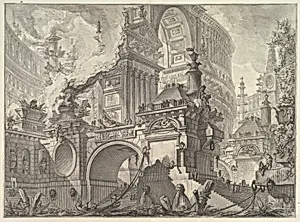
Parte di ampio magnifico Porto all'uso degli antichi Romani, ove si scuopre l'interno della gran Piazza pel Comercio... (Part of a spacious and magnificent Harbor for the use of the ancient Romans opening onto a large market square...), from "Opere Varie di Archiettura, prospettive, grotteschi, antichità; inventate, ed incise da Giambattista Piranesi Architetto Veneziano" (Various Works of Architecture, perspectives, grotesques, and antiquities; designed and etched by Giambattista Piranesi, Venetian Architect)
ca. 1749–50
Medium
Etching, engraving, drypoint; second state of seven (Robison)
Dimensions
Mat: 8 11/16 x 11 in. (22 x 28 cm) Sheet: 19 1/2 x 25 3/16 in. (49.5 x 64 cm) Plate: 15 3/4 x 21 7/16 in. (40 x 54.5 cm)
Classification
Prints
Department
Drawings and Prints
Museum
Metropolitan Museum of Art, New York, NY
Credit
Harris Brisbane Dick Fund, 1937
Accession Number
37.45.3(41)
Rights
Public Domain
Tags
Art Historical Context
Step into the imagined grandeur of ancient Rome with Giovanni Battista Piranesi's etchingParte di ampio magnifico Porto all'uso degli antichi Romani* (ca. 1749–50), from his seminal series *Opere Varie di Architetture, prospettive, grotteschi, antichità*. This second state of seven captures a sprawling harbor alive with boats, towering arches, and crumbling ruins that frame a vast market square. Piranesi, a visionary Venetian architect and printmaker, blends meticulous observation of Roman antiquities with fantastical invention, evoking the majesty of a lost empire. Piranesi's work epitomizes the 18th-century veduta tradition—topographical views elevated to dramatic fantasy—fueling the era's neoclassical revival. Amid Europe's obsession with classical heritage, his prints romanticized ruins as sublime testaments to human ambition, inspiring architects like John Soane. Here, the interplay of light through arches and the bustle of implied commerce transport viewers to an idealized ancient port, rich with arches, vessels, and weathered stone. Masterfully executed in etching, engraving, and drypoint on a grand plate (15 3/4 x 21 7/16 in.), this piece from The Metropolitan Museum of Art's collection highlights Piranesi's technical prowess in creating depth and texture. A captivating window into Enlightenment dreams of antiquity, it invites us to ponder the enduring allure of Rome's shadowed splendor.
About the Artist
Giovanni Battista Piranesi|Giovanni Bouchard · 1720–1778
Giovanni Battista Piranesi (1720–1778) was an Italian printmaker, architect, and antiquarian whose visionary etchings of Rome and imaginary prisons revolutionized architectural representation and profoundly influenced both Neoclassicism and Romanticism. Piranesi stands as one of the most important printmakers of the eighteenth century, fundamentally shaping European perceptions of ancient Rome an...