
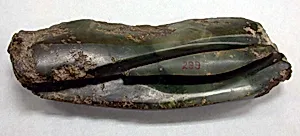
Partly Worked Piece of Jadeite
Unknown Artist
Medium
Jadeite
Dimensions
L. 11 1/4 in. (28.5 cm); W. 3 15/16 in. (10 cm); D. 1 7/8 in. (4.8 cm)
Classification
Jade
Culture
New Zealand
Department
Asian Art
Museum
Metropolitan Museum of Art, New York, NY
Credit
Gift of Heber R. Bishop, 1902
Accession Number
02.18.299
Rights
Public Domain
Art Historical Context
Behold this intriguing *Partly Worked Piece of Jade*, a testament to ancient craftsmanship from New Zealand's rich cultural heritage. Carved from lustrous jadeite—a dense, resilient greenstone prized for its toughness—this elongated form measures 11¼ inches (28.5 cm) in length, tapering to 3⅞ inches (10 cm) and 1⅞ inches (4.8 cm) deep. Its "partly worked" state the early stages of shaping, with smooth, polished surfaces emerging alongside rougher, unrefined edges, offering visitors a rare glimpse into the labor-intensive process. In New Zealand's Māori tradition, jadeite, known as pounamu, held profound spiritual and practical significance. Valued more than gold, it was meticulously shaped through abrasion with sandstone or other stones, as its hardness defied metal tools. This piece likely anticipated transformation into a tool, weapon like a mere (short club), or adornment, embodying mana (prestige) and ancestral connections. Though the artist and exact date remain unknown, its presence in the Metropolitan Museum of Art's Asian Art Department underscores global appreciation for Pacific artistry. Generously gifted by Heber R. Bishop in 1902, this artifact bridges continents, inviting us to ponder the hands that began its journey and the stories etched in its enduring stone.