
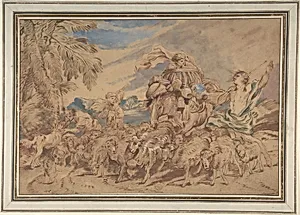
Pastoral Scene: Shepherds and Their Flock
Medium
Brush, brown, red-brown, blue, green, and white paint
Dimensions
10 3/4 x 16 1/16 in. (27.3 x 40.8 cm)
Classification
Drawings
Department
Drawings and Prints
Museum
Metropolitan Museum of Art, New York, NY
Credit
Rogers Fund, 1908
Accession Number
08.227.23
Rights
Public Domain
Tags
Art Historical Context
Behold the tranquil *Pastoral Scene: Shepherd and Their Flock*, a captivating drawing attributed to Giovanni Benedetto Castiglione (Il Grechetto), the 17th-century Italian Baroque master, with possible involvement from French artist Michel Corneille the Younger. This intimate work (10 3/4 x 16 1/16 in.) transports viewers to an idyllic countryside, where shepherds tend their woolly flock amid rolling landscapes—a timeless motif evoking harmony between humanity and nature. Crafted with brush and a palette of brown, red-brown, blue, green, and white paints, the piece exemplifies Baroque draftsmanship's fluidity. Castiglione, renowned for his energetic animals and figures inspired by classical antiquity, likely employed loose washes to capture light and movement, creating depth on paper without the rigidity of line work. Such techniques highlight the era's shift toward expressive, painterly drawings, bridging studio sketches and finished compositions. Acquired through the Rogers Fund in 1908 and housed in the Metropolitan Museum of Art's Drawings and Prints department, this undated gem reflects pastoral art's cultural allure: an escape from urban strife, celebrating rural simplicity in the Baroque imagination. A perfect pause for reflection amid the museum's treasures.
About the Artist
Giovanni Benedetto Castiglione (Il Grechetto)|Michel Corneille the Younger · 1609–1664
Giovanni Benedetto Castiglione, known as Il Grechetto, was baptized on March 23, 1609, in Genoa and died on May 5, 1664, in Mantua. Born into a large family, he collaborated closely with his brother Salvatore, an artist who shared his talents, and later taught his son Francesco, whose works were sometimes confused with his own. His parents placed him in the studio of Giovanni Battista Paggi, where...