
Patrol (Esplorazione)
1888/1890
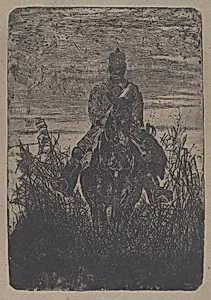
Medium
etching on brown paper (artist's proof)
Dimensions
sheet: 26 × 20 cm (10 1/4 × 7 7/8 in.) [irregular] plate: 22 × 15 cm (8 11/16 × 5 7/8 in.)
Classification
Department
CG-E
Museum
National Gallery of Art, Washington, D.C.
Credit
The Ahmanson Foundation
Accession Number
2013.31.3
Rights
Public Domain
Art Historical Context
Giovanni Fattori's *Patrol (Esplorazione)*, created between 1888 and 1890, is a striking etching on brown paper—an artist's proof that offers an intimate glimpse into the master's printmaking process. Measuring just 26 × 20 cm overall, with a plate of 22 × 15 cm, this small-scale work invites close contemplation, its irregular sheet edges hinting at the experimental nature of proofs pulled directly for the artist's approval. Housed in the National Gallery of Art's print collection, thanks to The Ahmanson Foundation, it exemplifies Fattori's late-career exploration of etching as a medium for precision and tonal depth. As a leader of the Macchiaioli movement in 19th-century Italy—a group of realist painters who pioneered plein-air techniques and an emphasis on light and atmosphere, foreshadowing Impressionism—Fattori brought his revolutionary approach to printmaking. Etching allowed him to incise fine lines into a metal plate, bitten by acid to create rich, velvety blacks and subtle grays on the warm brown paper, evoking the rugged terrains and human endeavors of unified Italy. The title suggests a scene of military exploration or patrol, aligning with Fattori's recurring themes from the Risorgimento era. This rare artist's proof, uneditioned and uniquely textured, underscores etching's technical virtuosity and Fattori's versatility beyond oil painting. Visitors will appreciate how it captures the movement's commitment to truthfulness in everyday heroism, bridging Italy's artistic past with modern sensibilities.
About the Artist
Giovanni Fattori · 1825–1908
Giovanni Fattori (1825–1908) was born in Livorno and showed such aptitude for drawing that his family redirected him from a planned commercial education to an artistic apprenticeship under the local painter Giuseppe Baldini. In 1846 he moved to Florence, where he studied under Giuseppe Bezzuoli and attended the Academy of Fine Arts. His early work followed the conventions of historical and religio...