
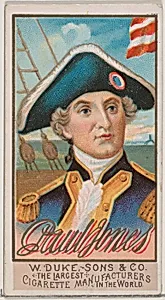
Paul Jones, from the series Great Americans (N76) for Duke brand cigarettes
Medium
Commercial color lithograph
Dimensions
Sheet: 2 3/4 × 1 1/2 in. (7 × 3.8 cm)
Classification
Prints|Ephemera
Department
Drawings and Prints
Museum
Metropolitan Museum of Art, New York, NY
Credit
The Jefferson R. Burdick Collection, Gift of Jefferson R. Burdick
Accession Number
63.350.204.76.29
Rights
Public Domain
Tags
Art Historical Context
Step into the vibrant world of 19th American advertising with this petite chromolithograph, *Paul Jones*, from W. Duke, Sons & Co.'s "Great Americans (N76 series, produced in 1888. Tucked into packs of Duke brand cigarettes, collectible cards—measuring just 2¾ × 1½ inches—were a clever marketing ploy by the tobacco giant to hook smokers and enthusiasts alike. Featuring the legendary Revolutionary War naval hero John Paul Jones, the card immortalizes his stern portrait against a bold red background, emblematic of patriotic fervor in post-Civil War America. Chromolithography, the era's breakthrough in color printing, allowed for vivid, mass-produced images that mimicked fine art at a fraction of the cost. This technique layered up to 30 lithographic stones for rich hues, transforming everyday ephemera into miniature treasures. Paul Jones, famed for his defiant cry "I have not yet begun to fight!" during the 1779 Battle of Flamborough Head, symbolized unyielding American resolve—perfect for Duke's bid to align their product with national pride. Today, housed in the Metropolitan Museum of Art's Jefferson R. Burdick Collection, this card highlights the intersection of commerce, collecting, and culture. Once discarded as "trade cards," these artifacts reveal how Gilded Age businesses packaged history for the masses, sparking a hobby that endures in museums worldwide. A tiny window into big ambitions!
About the Artist
W. Duke, Sons & Co. · 1870–1920
**W. Duke, Sons & Co.: Pioneers of Chromolithographic Trade Card Art** W. Duke, Sons & Co., an American tobacco manufacturer, emerged from the entrepreneurial vision of Washington Duke (1820–1905) and his sons in Durham, North Carolina. After the Civil War, Washington abandoned farming in 1874 to join his eldest son, Brodie L. Duke, in the burgeoning tobacco trade, establishing a factory that for...