
Paul Strand
1919
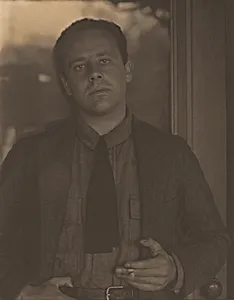
Medium
palladium print
Dimensions
image: 24.5 x 19.5 cm (9 5/8 x 7 11/16 in.) sheet: 25.2 x 20.2 cm (9 15/16 x 7 15/16 in.)
Classification
Photograph
Department
CPH
Museum
National Gallery of Art, Washington, D.C.
Credit
Alfred Stieglitz Collection
Accession Number
1949.3.411
Rights
Public Domain
Art Historical Context
This 1919 palladium print by Alfred Stieglitz captures fellow photographer Paul Strand in a quietly powerful portrait. Stieglitz, a figure in establishing photography as a fine art, frequently turned his lens toward the artists and thinkers of his circle. Here he presents Strand with directness and intimacy, highlighting the younger artist’s thoughtful gaze and distinctive features against a simple background. Created at a moment when Stieglitz was championing “straight photography,” the image reflects his shift away from painterly effects toward crisp, unmanipulated vision. Strand himself would become a leading voice in this modernist approach, and the portrait stands as both a personal document and a statement of shared artistic ideals in the years following World War I. The choice of palladium print is significant. This hand-coated process yields exceptionally rich, matte tones and subtle gradations that enhance the photograph’s tactile, almost sculptural quality. Such prints underscore Stieglitz’s belief that the photographic medium could achieve the same expressive depth as painting or drawing, elevating it within the National Gallery of Art’s renowned Alfred Stieglitz Collection.
About the Artist
Alfred Stieglitz · 1864–1946
Alfred Stieglitz (1864-1946) was a pioneering American photographer, art dealer, publisher, and advocate for the Modernist movement who was instrumental over his 50-year career in making photography an accepted art form. Born in Hoboken, New Jersey, to German Jewish immigrant parents, Stieglitz spent his formative years studying mechanical engineering in Berlin, where he discovered photography in ...