
Paz-Hut-A-Saka
Unknown Artist
19th century
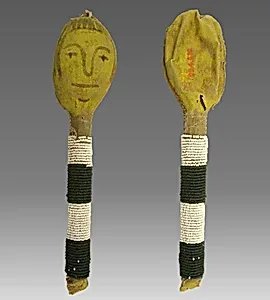
Medium
Wood, skin, shell beads
Dimensions
Overall: 5.7 x 23.5cm (2 1/4 x 9 1/4in.)
Classification
Idiophone-Shaken-rattle
Culture
Native American (Cheyenne, Sioux or Dakota)
Department
Musical Instruments
Museum
Metropolitan Museum of Art, New York, NY
Credit
The Crosby Brown Collection of Musical Instruments, 1889
Accession Number
89.4.570
Rights
Public Domain
Art Historical Context
Nestled in the Metropolitan Museum of Art's Crosby Brown Collection of Musical Instruments the *Paz-Hut-A-Saka* is a captivating 19th-century shaken from Native American cultures of the Great Plains, possibly Cheyenne, Sioux, or. Measuring just 5.7 x 23. cm, this compact idiophone—where sound arises from the instrument's own vibrations—exemplifies the ingenuity of Indigenous craftsmanship. Acquired in 1889, it offers a window into the spiritual and communal life of these nomadic horse cultures, who relied on such objects for rituals, dances, and storytelling. Crafted from wood, skin, and shell beads, the rattle's construction highlights resourcefulness with natural materials. The wooden body, likely hollowed and covered with taut skin, would contain small objects like beads or seeds that clatter when shaken, producing rhythmic percussion. Shell beads, traded or gathered from distant sources, add both sonic texture and decorative flair, symbolizing cultural exchange across vast landscapes. In Plains societies, rattles like this were vital to ceremonies, invoking the spirits and marking life's transitions. Though its exact maker remains unknown, the *Paz-Hut-A-Saka* endures as a testament to the artistry and resilience of 19th-century Native peoples, bridging sound, tradition, and history in a single, handheld treasure.