
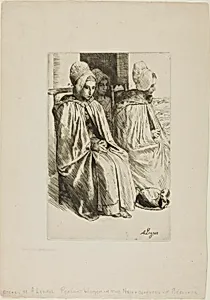
Peasant Women from Near Boulogne
1873
Medium
Etching on cream laid paper
Dimensions
Plate: 22.8 × 14.9 cm (9 × 5 7/8 in.); Sheet: 36.2 × 25.1 cm (14 5/16 × 9 15/16 in.)
Classification
etching
Department
Prints and Drawings
Museum
Art Institute of Chicago
Accession Number
18942
Rights
Public Domain
Art Historical Context
Alphonse Legros's *Peasant Women from Nearlogne* (1873) is a poignant etching on cream laid paper, housed in the Art Institute of Chicago's and Drawings department. Measuring 22.8 × 14.9 cm on the plate, this intimate work captures the quiet dignity of rural life along the northern French coast near Boulogne-sur-Mer. Legros, a masterful 19th-century printmaker drew inspiration from everyday scenes, rendering these women with a realist's eye for texture and form. Etching, Legros's preferred medium, involves coating a copper plate with acid-resistant ground, scratching lines through it, and immersing it in acid to "bite" the grooves. This technique allowed for exquisite detail and tonal subtlety, making prints like this one both affordable and accessible to a broader audience beyond oil paintings. Printed on laid paper—characterized by its visible chain lines— the work exemplifies the technical precision of French printmaking during the Third Republic era. In an age of rapid industrialization, Legros's focus on peasant subjects highlighted cultural shifts from agrarian traditions, offering viewers a nostalgic glimpse into vanishing rural worlds. A gem for print enthusiasts, it invites us to appreciate the artistry in the ordinary.
About the Artist
Alphonse Legros · 1837–1911
Alphonse Legros (1837–1911) was born in Dijon, France, and trained in Paris at the drawing school of Horace Lecoq de Boisbaudran, whose unconventional teaching method — which emphasised memory drawing and acute observation over academic convention — would leave a lasting mark on Legros's practice. At Lecoq's school he formed friendships with Jules Dalou and Auguste Rodin that endured throughout hi...