
Pendant
Unknown Artist
3rd–12th century
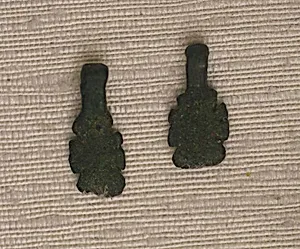
Medium
Bronze
Dimensions
A: H. 9/16 in. (1.4 cm) W. 1/4 in. (0.6 cm) D. 1/8 in. (0.3 cm) Wt. 0.01 oz. (0.3 g) B: H. 1/2 in. (1.2 cm) W. 1/4 in. (0.6 cm) D. 1/8 in. (0.3 cm) Wt. 0.02 oz. (0.6 g)
Classification
Metal
Department
Islamic Art
Museum
Metropolitan Museum of Art, New York, NY
Credit
Gift of Helen Miller Gould, 1910
Accession Number
10.130.3127a, b
Rights
Public Domain
Tags
Art Historical Context
This delicate bronze pendant, dating from the 3rd to 12th century, exemplifies the exquisite metalwork of the Islamic world. Comprising two small components—A measuring just 9/16 inch high and weighing a mere 0.01 oz., and B slightly smaller at 1/2 inch high and 0.02 oz.—it was likely crafted for personal adornment, perhaps as a necklace or amulet. Its diminutive scale and lightweight bronze construction highlight the technical finesse of ancient artisans, who cast or hammered metal into functional yet elegant forms suitable for daily wear. In the Department of Islamic Art at The Metropolitan Museum of Art, such pendants reflect the cultural continuum from late antiquity through the medieval Islamic era. Bronze, a durable and accessible medium, was widely used for jewelry across regions like the Middle East and North Africa, often imbued with protective or symbolic significance. Though the artist's identity remains unknown, the piece's survival speaks to the enduring value placed on portable art objects in trade and daily life. A generous gift from Helen Miller Gould in 1910, this pendant invites visitors to ponder the intimate connections between people and their treasures across a millennium, bridging ancient craftsmanship with modern appreciation.