
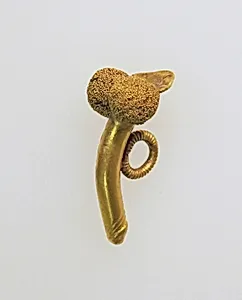
Pendant in the form of a phallos
Unknown Artist
Medium
Gold
Dimensions
Other: 1/2 × 9/16 × 1 1/16 in. (1.2 × 1.4 × 2.8 cm)
Classification
Gold and Silver
Culture
Etruscan
Department
Greek and Roman Art
Museum
Metropolitan Museum of Art, New York, NY
Credit
Purchase by subscription, 1895
Accession Number
95.15.275
Rights
Public Domain
Art Historical Context
This delicate gold pendant, shaped as a phallos, exemplifies the exquisite metalworking of the ancient Etruscans, a sophisticated civilization that flourished in central Italy from around 900 to 100 BCE. Crafted from pure gold, it measures just 1/2 × 9/16 × 1 1/16 inches, making it a perfect piece of personal jewelry—likely worn as an amulet suspended from a chain or cord. The Etruscans were renowned for their mastery of granulation and filigree techniques, though specifics here remain unknown, this tiny object showcases their skill in transforming precious metal into intimate, symbolic adornments. In Etruscan culture, phallic imagery held profound significance, often serving as protective talismans against evil spirits, promoting fertility, and ensuring vitality. Such pendants were common accessories for both men and women, blending eroticism with apotropaic (evil-averting) magic in everyday life. This artifact bridges the sensual and the sacred, reflecting broader Mediterranean traditions shared with Greeks and Romans. Acquired by subscription in 1895, the pendant now resides in the Metropolitan Museum of Art's Greek and Roman Art department, offering visitors a tangible glimpse into Etruscan beliefs and artistry. Its survival underscores the enduring allure of these ancient emblems.