
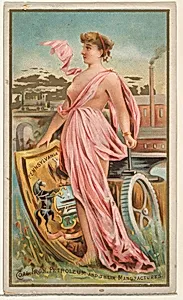
Pennsylvania, from the Industries of States series (N117) issued by Duke Sons & Co. to promote Honest Long Cut Tobacco
Medium
Commercial color lithograph
Dimensions
Sheet: 4 3/16 × 2 1/2 in. (10.6 × 6.3 cm)
Classification
Prints|Ephemera
Department
Drawings and Prints
Museum
Metropolitan Museum of Art, New York, NY
Credit
The Jefferson R. Burdick Collection, Gift of Jefferson R. Burdick
Accession Number
63.350.206.117.9
Rights
Public Domain
Tags
Art Historical Context
Step into the vibrant world of 19th American advertising with *Pennsylvania, from the Industries of States series (N117)*, a charming commercial color lithograph produced in 1889 by W. Duke, Sons & Co. This petite card (just 4 3/16 × 2 1/2 inches) was issued to promote Honest Long Cut Tobacco, likely tucked into cigarette packages as a collectible insert. Part of a series celebrating U.S. states, it features allegorical women with shields—symbols evoking strength and pride in Pennsylvania's booming industries like steel, coal, and manufacturing during the Gilded Age. Printed via color lithography, a revolutionary technique that allowed for vivid, mass-produced imagery on a budget, this ephemera exemplifies the era's commercial art. Duke Sons & Co., a powerhouse tobacco firm led by the Duke family, used such cards to build brand loyalty amid fierce competition, blending patriotism with product hype. These inserts fueled a collecting craze, turning everyday promotions into coveted keepsakes. Today, housed in The Metropolitan Museum of Art's Jefferson R. Burdick Collection, this piece highlights how advertising shaped popular culture, immortalizing regional identity through accessible, eye-catching design. A tiny window into America's industrial might and clever marketing savvy!
About the Artist
W. Duke, Sons & Co. · 1870–1920
**W. Duke, Sons & Co.: Pioneers of Chromolithographic Trade Card Art** W. Duke, Sons & Co., an American tobacco manufacturer, emerged from the entrepreneurial vision of Washington Duke (1820–1905) and his sons in Durham, North Carolina. After the Civil War, Washington abandoned farming in 1874 to join his eldest son, Brodie L. Duke, in the burgeoning tobacco trade, establishing a factory that for...