
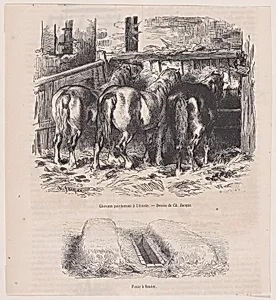
Percheron Horses in a Stable and A Manure Pit, from "Le Magasin Pittoresque"
ca. 1852
Medium
Wood engraving
Dimensions
Sheet (Trimmed): 7 3/4 × 6 15/16 in. (19.7 × 17.7 cm) Image: 4 3/4 × 6 1/4 in. (12 × 15.8 cm) Image: 1 9/16 × 4 5/16 in. (4 × 11 cm)
Classification
Prints
Department
Drawings and Prints
Museum
Metropolitan Museum of Art, New York, NY
Credit
Harris Brisbane Dick Fund, 1933
Accession Number
32.36.12
Rights
Public Domain
Tags
Art Historical Context
Charles Jacque’s wood engraving *Percheron Horses in a Stable and A Manure Pit* captures a candid moment of 19th-century rural life. Created around 1852 for the French illustrated magazine *Le Magasin Pittoresque*, the print shows sturdy Percheron draft horses—renowned for their strength and gentle temperament—within a working stable, complete with the practical, unglamorous presence of a manure pit. Jacque, associated with the Barbizon school, specialized in sensitive portrayals of farm animals and countryside scenes, bringing dignity to subjects often overlooked in art. Wood engraving was ideally suited to periodical illustration, allowing fine lines and tonal contrast to be reproduced affordably for a wide audience. Jacque’s precise technique renders the horses’ powerful forms and textured surroundings with clarity, reflecting the era’s growing interest in realism and everyday agricultural labor. This work offers modern viewers a window into mid-19th-century France, where horses remained essential to farming and transport. By including both noble animals and the realities of stable maintenance, Jacque invites appreciation for the full cycle of rural existence rather than an idealized version.
About the Artist
Charles Jacque · 1813–1894
Charles-Émile Jacque (1813–1894) was a pioneering French painter, engraver, and illustrator whose career bridged the worlds of printmaking and pastoral painting. Born in Paris amid a difficult childhood, he apprenticed at age seventeen to a map engraver, mastering drypoint technique and producing his first etching in 1830—a copy of a head after Rembrandt. After serving seven years in the French Ar...