
7/10
1633 - 1638
Medium
paper
Dimensions
650; 208
Rights
Public Domain
About this artwork
hoogte 208 mm (twee aan elkaar geplakte bladen) x breedte 650 mm
Art Historical Context
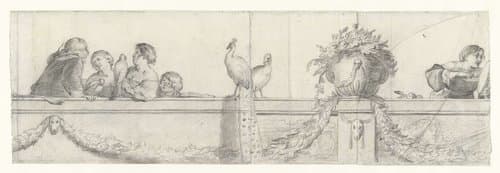
Cornelis Holsteyn’s “7/10,” created between 1633 and 1638, is a modest yet intriguing work on paper from the Dutch Golden Age. Measuring just 208 mm high by 650 mm wide, the piece consists of two sheets carefully glued together to form a long, narrow strip—an unusual format that suggests it may have served as a preparatory design, frieze study, or decorative border. Holsteyn, active in Haarlem and Amsterdam, was known for portraits and allegorical scenes, and this elongated support allowed him to explore continuous compositions that would have been difficult on a single sheet. The title “7/10” implies the work belongs to a numbered series, perhaps studies or designs produced for a larger project such as print illustrations or interior decoration. In an era when paper was prized for its versatility, artists frequently joined sheets to accommodate panoramic ideas before transferring them to panel, canvas, or engraving. The surviving dimensions and construction reveal both the practical ingenuity and the intimate scale at which Dutch artists worked during this period of artistic innovation.
About the Artist
Cornelis Holsteyn · 1618–1658
Cornelis Holsteyn studied under his father Pieter Holsteyn the Elder. He has often been confused with Cornelis Cornelissen. Holsteyn engraved numerous plates from his own drawings. Comment on works: History; Genre.