
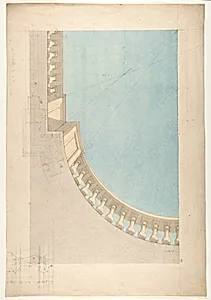
Perspectival study for one quadrant of a ceiling design including a trompe l'oeil balustrade
second half 19th century
Medium
graphite, pen and ink, and watercolor on wove paper
Classification
Drawings
Department
Drawings and Prints
Museum
Metropolitan Museum of Art, New York, NY
Credit
Dodge Fund, 1967
Accession Number
67.827.429
Rights
Public Domain
Tags
Art Historical Context
This exquisite perspectival study, created by French artists Jules-EdmondCharles Lachaise andène-Pierre Gourdet in second half of the th century, captures one quadrant of an ambitious ceiling design. Featuring a trompe l'oeil balustrade optical illusion that mimics a three-dimensional stone railing—the drawing showcases the era's fascination with architectural fantasy. Such preparatory sketches were essential for grand interior projects, like opera houses or aristocratic salons, where illusionistic ceilings blurred the line between painted surface and reality. Executed in graphite, pen and ink, and watercolor on wove paper, the work highlights masterful techniques: precise graphite underdrawings for perspective, fluid ink lines for architectural details, and subtle watercolor washes for depth and shadow. This mixed-media approach on durable wove paper allowed for the intricate shading needed to fool the eye, reflecting 19th-century advancements in drafting tools and a revival of Renaissance illusionism in French decorative arts. Housed in the Metropolitan Museum of Art's Drawings and Prints department (acquired via the Dodge Fund in 1967), this piece offers a window into the collaborative world of 19th-century architectural draftsmen. It underscores how such studies bridged engineering precision with artistic virtuosity, enchanting viewers then and now with their deceptive realism.
About the Artist
Jules-Edmond-Charles Lachaise|Eugène-Pierre Gourdet · 1897–1897
Jules-Edmond-Charles Lachaise, born Jules Lachaise on September 2, 1836, in Paris, emerged as a prominent French painter and draughtsman specializing in lavish interior decorations during the Second Empire and beyond. Little is known about his early life and formal training, though he married Berthe Gourdet in 1866, forging a close professional partnership with her brother, the decorator Eugène-Pi...