
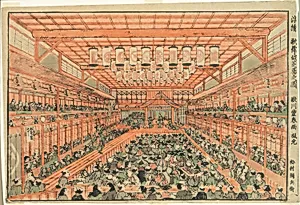
Perspective Picture of a Kabuki Theater (Uki-e Kabuki shibai no zu)
c. 1776
Medium
Color woodblock print; oban
Dimensions
25.6 × 38.6 cm (10 1/8 × 15 1/4 in.)
Classification
woodblock print
Department
Arts of Asia
Museum
Art Institute of Chicago
Accession Number
15804
Rights
Public Domain
Art Historical Context
Step into the bustling world of 18th-century Edo (modern Tokyo) with Utagawa Toyoharu *Perspective Picture of a Kabuki TheaterUki-e Kabuki shibai no zu)*, created around 1776. This vibrant color woodblock print, in the generous oban format measuring 25.6 × 38.6 cm, captures the electric atmosphere of a Kabuki performance. Toyoharu, a pioneering of the Utagawa school masterfully renders the theater's interior, drawing viewers into the wooden galleries filled with rapt audiences and dramatic stage action. What makes this print revolutionary is its "uki-e" style—"floating pictures"—which introduced Western linear perspective to Japanese art. Before Toyoharu, ukiyo-e prints typically used traditional flattened compositions, but here, vanishing points create astonishing depth, making the receding theater boxes and proscenium arch feel immersive and three-dimensional. Printed on paper using intricate woodblocks for bold colors and fine details, it exemplifies the technical brilliance of Edo-period printmaking. Kabuki theater was Japan's premier spectacle, blending music, dance, and melodrama with all-male casts in extravagant costumes. Toyoharu's work not only documents this cultural phenomenon but celebrates the "floating world" of fleeting pleasures. Housed in the Art Institute of Chicago's Arts of Asia department, it invites us to ponder how art bridged East and West, forever changing visual storytelling in Japan.
About the Artist
Utagawa Toyoharu · 1735–1814
Utagawa Toyoharu (1735–1814) holds a foundational place in the history of Japanese printmaking as the founder of the prolific and long-lived Utagawa school, which would go on to produce some of the most celebrated names in ukiyo-e, including Hiroshige and Kuniyoshi. Born in what is now Hyogo Prefecture, Toyoharu moved to Edo, where he studied under Toriyama Sekien and later explored the Kano schoo...