
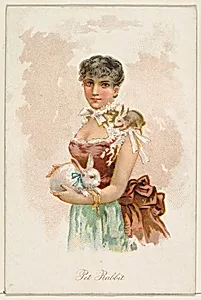
Pet Rabbit, from the Household Pets series (N194) issued by Wm. S. Kimball & Co.
Medium
Commercial color lithograph
Dimensions
Sheet: 3 3/4 × 2 1/2 in. (9.5 × 6.3 cm)
Classification
Prints|Ephemera
Department
Drawings and Prints
Museum
Metropolitan Museum of Art, New York, NY
Credit
The Jefferson R. Burdick Collection, Gift of Jefferson R. Burdick
Accession Number
63.350.216.194.23
Rights
Public Domain
Tags
Art Historical Context
This charming 1891 color lithograph titled *Pet Rabbit* comes from the Household Pets series (N194), issued by Wm. S. Kimball & Co. as a premium inside cigarette packages. Produced by the American Tobacco Company in collaboration with printer Julius Bien & Co., these small cards—measuring just 3¾ by 2½ inches—were designed to delight consumers and encourage collecting. The commercial color lithography technique allowed for bright, detailed images that could be mass-produced affordably, turning ordinary tobacco purchases into miniature art experiences. The card reflects the Victorian era’s growing affection for household pets and domestic scenes, often featuring women alongside animals like rabbits to evoke warmth and familiarity. As ephemera, it captures how popular visual culture reached everyday audiences through advertising, blending entertainment with subtle marketing. Today, *Pet Rabbit* resides in the Metropolitan Museum of Art’s Burdick Collection, where it offers insight into 19th-century printing innovations and the social history of collecting. Such cards preserve a delightful snapshot of how art and commerce intersected in daily life.
About the Artist
American Tobacco Company|William S. Kimball & Company|Julius Bien & Co. · 1826–1909
**American Tobacco Company (1890–1911)** Founded on January 31, 1890, in Durham, North Carolina, by James Buchanan Duke, the American Tobacco Company emerged from the consolidation of five major U.S. tobacco manufacturers: W. Duke & Sons, Allen & Ginter, Goodwin & Company, W.S. Kimball & Co., and Kinney Brothers. Under Duke's aggressive leadership, it rapidly achieved monopoly status, controlling...